



.png)
Advanced Research
Scaling Up Civic Participation: How Remesh Can Bring Cypriot Voices into the Peace Process

.png)

.png)
Read Article

.png)
.png)

Professor Charis Psaltis, University of Cyprus Member of C-Up Technical Advisory Board ; Dr Meltem Onurkan-Samani, Founder and Director of CPDC C-Up Lead Professor; Neophytos Loizides, University of Warwick Member of C-Up Technical Advisory Board
September 23, 2026
Market Research
Articles
Advanced Research
Scaling Up Civic Participation: How Remesh Can Bring Cypriot Voices into the Peace Process
Learn More
Professor Charis Psaltis, University of Cyprus Member of C-Up Technical Advisory Board ; Dr Meltem Onurkan-Samani, Founder and Director of CPDC C-Up Lead Professor; Neophytos Loizides, University of Warwick Member of C-Up Technical Advisory Board
September 23, 2026
Market Research
Articles
.png)
Advanced Research
What Tools Do Consultants Use to Run Employee Listening for Clients?
Read Article
Team Remesh
September 23, 2026
Employee Research
Articles
Advanced Research
What Tools Do Consultants Use to Run Employee Listening for Clients?
Learn More
Team Remesh
September 23, 2026
Employee Research
Articles
.png)
Advanced Research
50 Employee Benefits Survey Questions to Ask Before Open Enrollment
Read Article
Team Remesh
September 18, 2026
Employee Research
Articles
Advanced Research
50 Employee Benefits Survey Questions to Ask Before Open Enrollment
Learn More
Team Remesh
September 18, 2026
Employee Research
Articles

Advanced Research
Beyond Simplistic Analysis: Using Advanced Methods to Understand Complex Real-World Problems
Read Article
Team Remesh
September 16, 2026
Employee Research
Articles
Advanced Research
Beyond Simplistic Analysis: Using Advanced Methods to Understand Complex Real-World Problems
Learn More
Team Remesh
September 16, 2026
Employee Research
Articles
.png)
Advanced Research
What Really Drives Outcomes: Why key driver analysis needs more than one method
Read Article
Team Remesh
September 9, 2026
Employee Research
Articles
Advanced Research
What Really Drives Outcomes: Why key driver analysis needs more than one method
Learn More
Team Remesh
September 9, 2026
Employee Research
Articles
Advanced Research
From Question to Defensible Decision: 2026 at Remesh So Far
Read Article
Anthony Lam
September 9, 2026
Market Research
Articles
Advanced Research
From Question to Defensible Decision: 2026 at Remesh So Far
Learn More
Anthony Lam
September 9, 2026
Market Research
Articles

Advanced Research
When AI Makes Work Less Human
Read Article
Team Remesh
September 3, 2026
Employee Research
Articles
Advanced Research
When AI Makes Work Less Human
Learn More
Team Remesh
September 3, 2026
Employee Research
Articles
.png)
Advanced Research
Online Focus Group Platforms Compared: What Enterprise Insights Teams Should Evaluate
Read Article
Team Remesh
August 30, 2026
Market Research
Articles
Advanced Research
Online Focus Group Platforms Compared: What Enterprise Insights Teams Should Evaluate
Learn More
Team Remesh
August 30, 2026
Market Research
Articles
Tracking Challenges Over Time: A Conversational Approach
A single listening study tells you what people are saying now. A sequence of studies can show how the organization itself is changing — including how one improvement creates the next constraint.

.png)
How connected listening can show not only what changed, but how progress itself creates the next organizational challenge
The core idea: A single listening study tells you what people are saying now. A sequence of studies can show how the organization itself is changing — including how one improvement creates the next constraint.
Most employee listening is still treated as a set of snapshots. One study captures confidence. Another explores collaboration. A later conversation examines a strategic initiative. Each can be useful on its own — but the bigger opportunity is to connect them. When listening moments are viewed as parts of one evolving system, leaders can ask a more useful question: not only “What changed?” but “What is changing, what is persisting, and what does the organization need next?”
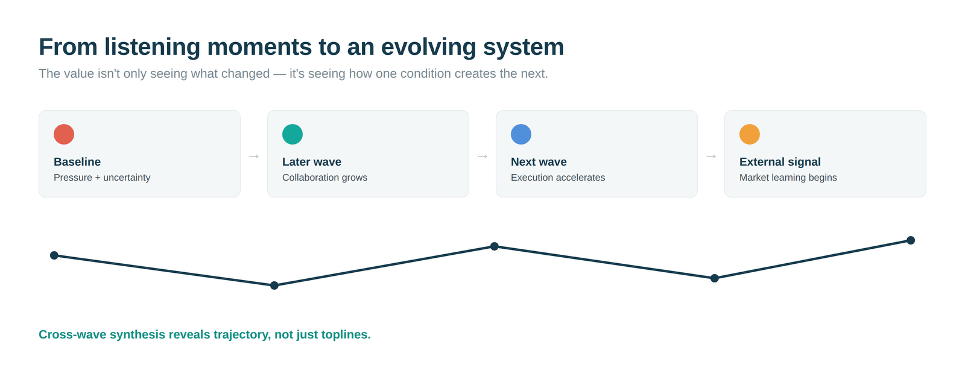
Illustrative anonymized visual based on the case trajectory.
A case in point: the problem moved
An internal IT business unit had conducted several Remesh conversations across the first part of the year. The early studies showed an organization under pressure: uneven confidence, a need to reignite growth, constrained resources, and a major product bet with outsized strategic importance. Leaders and employees largely agreed on the seriousness of the situation, but they experienced it differently. Leaders described the performance system — growth, market presence, revenue and execution. Employees described what it felt like to operate inside that system — morale, job security, stability and uncertainty.
Later conversations showed a meaningful shift. Employees increasingly described stronger cross-functional interaction, more open exchange of ideas and more coordinated involvement in work. A subsequent wave moved the discussion again: a major product initiative became a shared organizing focus, and employees could describe concrete ways they were contributing to execution. Finally, early client feedback moved the evidence from internal expectation into real-world use.
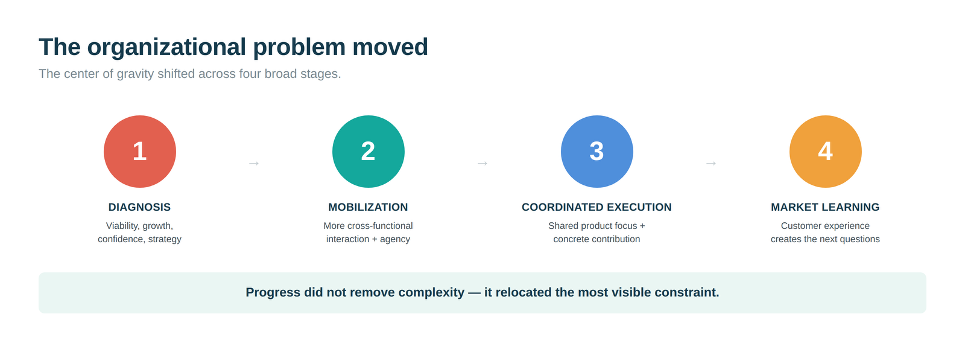
The sequence suggested a move from diagnosis to mobilization, coordinated execution and early market learning.
Progress changes the question
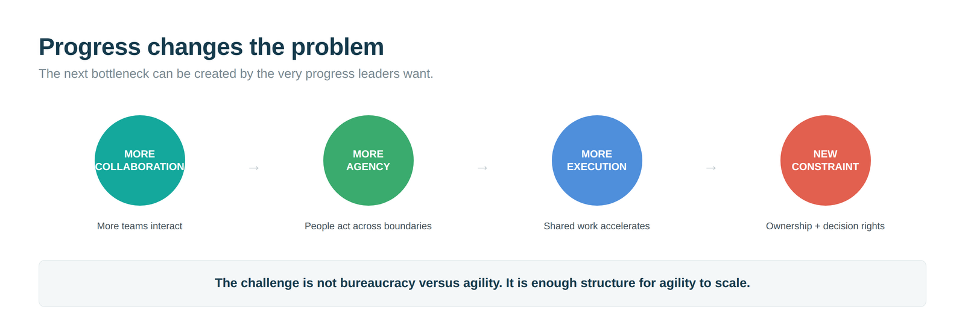
The most important finding was not simply that collaboration improved. It was that the nature of the organizational problem changed. As more people worked across functions and a shared initiative accelerated, employees began talking more explicitly about unclear ownership, overlapping responsibilities, decision rights and prioritization. Greater activity created more agency and speed — and simultaneously increased the need for lightweight coordination.
That distinction matters. The challenge was not “bureaucracy versus agility.” It was how to create enough structure for agility to work at scale. A single survey or focus group might have identified either collaboration or role clarity as an issue. The sequence showed the relationship between them: progress in one part of the system exposed the next constraint.
Why this matters for leaders
Organizational change rarely appears as a clean improvement curve. More often, progress changes the problem. Greater collaboration can reveal unclear decision rights. More autonomy can expose prioritization gaps. A sharper strategic focus can improve execution around one initiative while leaving broader uncertainty intact. Longitudinal mixed-methods listening helps leaders see those transitions as parts of one evolving system rather than disconnected findings.
It also changes the role of employee research. The goal is no longer only to report whether a score increased or whether a theme appeared. The goal is to understand where the organization is in its adaptation process, what is becoming possible, and what new friction is emerging because of that progress.
A practical way to start
Organizations do not necessarily need another listening program to begin. Many already have the raw material: recurring employee studies, town halls, retrospectives, change diagnostics, open-ended pulses, stakeholder conversations and customer feedback. The first step is to identify the relevant sequence, map the constructs that recur across studies, and distinguish what is directly comparable from what is only conceptually related.
That evidence discipline matters. If a topic was not asked about later, its absence is not evidence of improvement. If populations or wording changed, the comparison needs to be labeled accordingly. Preserving each wave as its own evidence environment makes it possible to integrate the story without pretending the data are more precise than they are.
The question is no longer only “What did people say?”
It is “What is changing — and what does the organization need next?”
Method note: This case integrates multiple listening moments across changing contexts and populations. The analysis is longitudinal at the evidence-system level; it does not imply that the same individuals were followed over time or that observed shifts were caused by a single intervention.
For more on moving from findings to decisions, see Closing the Gap: Turn Employee Feedback into Action.
You likely already have the sequence. Recurring pulses, town halls, retrospectives, stakeholder conversations, exit feedback. The work is connecting them.
If you want to see what your existing listening data says when it is read as one system instead of separate studies, request a demo.
-
Lorem ipsum dolor sit amet, consectetur adipiscing elit. Suspendisse varius enim in eros elementum tristique. Duis cursus, mi quis viverra ornare, eros dolor interdum nulla, ut commodo diam libero vitae erat. Aenean faucibus nibh et justo cursus id rutrum lorem imperdiet. Nunc ut sem vitae risus tristique posuere.
-
Lorem ipsum dolor sit amet, consectetur adipiscing elit. Suspendisse varius enim in eros elementum tristique. Duis cursus, mi quis viverra ornare, eros dolor interdum nulla, ut commodo diam libero vitae erat. Aenean faucibus nibh et justo cursus id rutrum lorem imperdiet. Nunc ut sem vitae risus tristique posuere.
-
More
Scaling Up Civic Participation: How Remesh Can Bring Cypriot Voices into the Peace Process
Read More
Learn More
Stay up-to date.
Stay ahead of the curve. Get it all. Or get what suits you. Our 101 material is great if you’re used to working with an agency. Are you a seasoned pro? Sign up to receive just our advanced materials.


