



.png)
Advanced Research
Scaling Up Civic Participation: How Remesh Can Bring Cypriot Voices into the Peace Process

.png)

.png)
Read Article

.png)
.png)

Professor Charis Psaltis, University of Cyprus Member of C-Up Technical Advisory Board ; Dr Meltem Onurkan-Samani, Founder and Director of CPDC C-Up Lead Professor; Neophytos Loizides, University of Warwick Member of C-Up Technical Advisory Board
September 23, 2026
Market Research
Articles
Advanced Research
Scaling Up Civic Participation: How Remesh Can Bring Cypriot Voices into the Peace Process
Learn More
Professor Charis Psaltis, University of Cyprus Member of C-Up Technical Advisory Board ; Dr Meltem Onurkan-Samani, Founder and Director of CPDC C-Up Lead Professor; Neophytos Loizides, University of Warwick Member of C-Up Technical Advisory Board
September 23, 2026
Market Research
Articles
.png)
Advanced Research
What Tools Do Consultants Use to Run Employee Listening for Clients?
Read Article
Team Remesh
September 23, 2026
Employee Research
Articles
Advanced Research
What Tools Do Consultants Use to Run Employee Listening for Clients?
Learn More
Team Remesh
September 23, 2026
Employee Research
Articles
.png)
Advanced Research
50 Employee Benefits Survey Questions to Ask Before Open Enrollment
Read Article
Team Remesh
September 18, 2026
Employee Research
Articles
Advanced Research
50 Employee Benefits Survey Questions to Ask Before Open Enrollment
Learn More
Team Remesh
September 18, 2026
Employee Research
Articles

Advanced Research
Beyond Simplistic Analysis: Using Advanced Methods to Understand Complex Real-World Problems
Read Article
Team Remesh
September 16, 2026
Employee Research
Articles
Advanced Research
Beyond Simplistic Analysis: Using Advanced Methods to Understand Complex Real-World Problems
Learn More
Team Remesh
September 16, 2026
Employee Research
Articles
.png)
Advanced Research
What Really Drives Outcomes: Why key driver analysis needs more than one method
Read Article
Team Remesh
September 9, 2026
Employee Research
Articles
Advanced Research
What Really Drives Outcomes: Why key driver analysis needs more than one method
Learn More
Team Remesh
September 9, 2026
Employee Research
Articles
Advanced Research
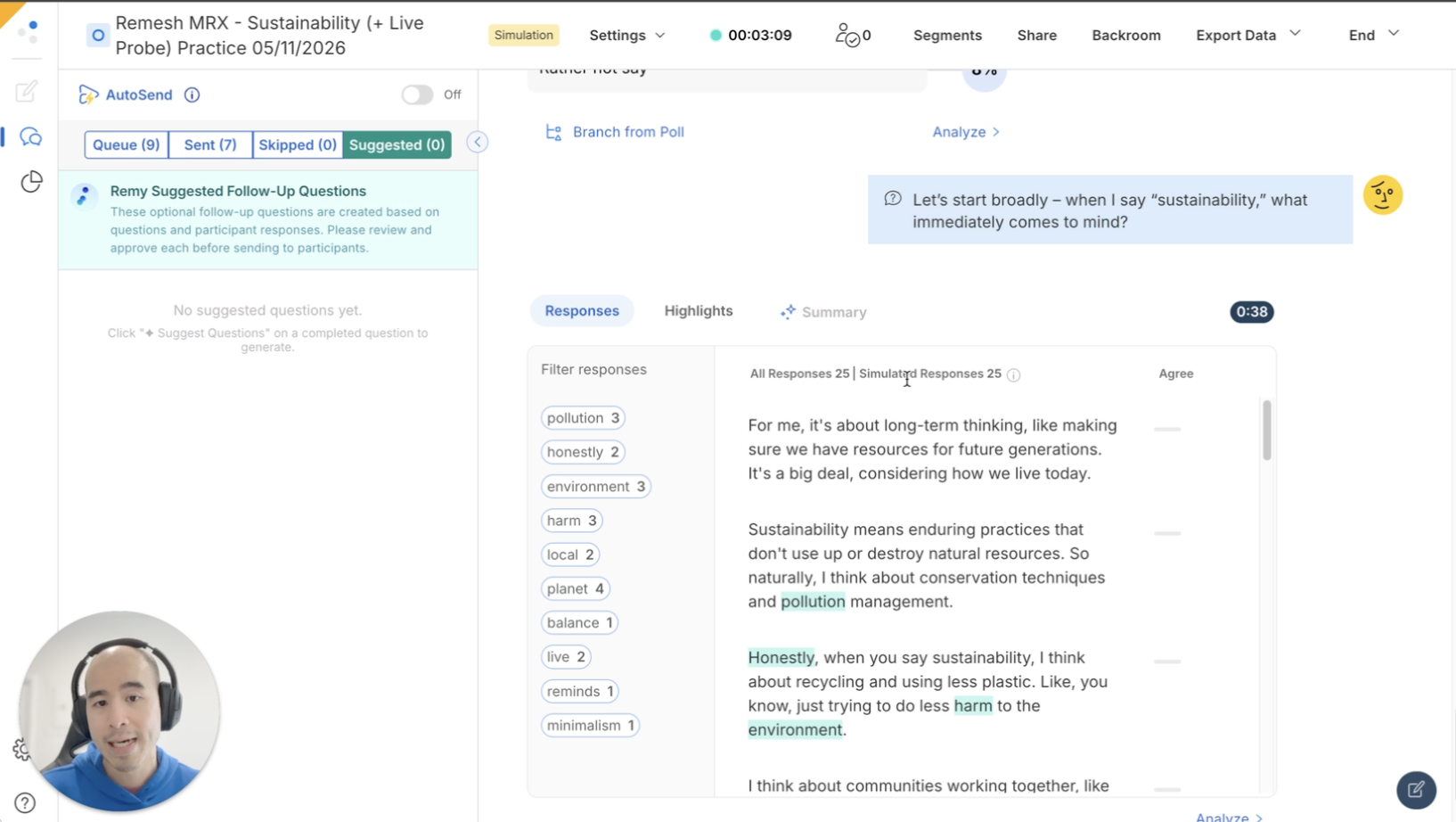
From Question to Defensible Decision: 2026 at Remesh So Far
Read Article
Anthony Lam
September 9, 2026
Market Research
Articles
Advanced Research
From Question to Defensible Decision: 2026 at Remesh So Far
Learn More
Anthony Lam
September 9, 2026
Market Research
Articles

Advanced Research
When AI Makes Work Less Human
Read Article
Team Remesh
September 3, 2026
Employee Research
Articles
Advanced Research
When AI Makes Work Less Human
Learn More
Team Remesh
September 3, 2026
Employee Research
Articles
.png)
Advanced Research
Online Focus Group Platforms Compared: What Enterprise Insights Teams Should Evaluate
Read Article
Team Remesh
August 30, 2026
Market Research
Articles
Advanced Research
Online Focus Group Platforms Compared: What Enterprise Insights Teams Should Evaluate
Learn More
Team Remesh
August 30, 2026
Market Research
Articles
.png)
Filling the Measurement Gap in AI-Powered Research
As researchers increasingly use generative AI to make sense of qualitative and mixed-methods data, an important methodological distinction can become easy to overlook: interpreting a pattern is not the same as measuring it.

.png)
LLMs are remarkably good at interpreting what people say. But interpretation and measurement are different analytical acts—and understanding the difference opens up a richer approach to mixed-methods research.
Large language models have changed what is possible with open-ended research. Give an LLM hundreds or thousands of responses and it can summarize them in seconds. It can identify themes, recognize similar ideas expressed in different language, compare perspectives, surface contradictions, generate hypotheses, and turn an enormous body of language into a coherent narrative. Those capabilities are extraordinarily useful. We use them. But at Remesh, we think they are only part of the opportunity.
As researchers increasingly use generative AI to make sense of qualitative and mixed-methods data, an important methodological distinction can become easy to overlook: interpreting a pattern is not the same as measuring it. We think of the space between those two activities as the measurement gap. The measurement gap is the distance between a plausible interpretation of a body of evidence and an empirical finding whose prevalence, relationships, structure, subgroup differences, predictive relevance, or robustness have actually been measured. This distinction has little to do with whether an LLM is “good” or “bad” at research. In fact, even a perfectly accurate LLM that never hallucinated would not make interpretation equivalent to measurement. That is because the two activities answer different questions.
An LLM can help us understand what a body of language appears to mean. Computational analysis can help us investigate what patterns actually exist within the underlying data. And mixed-methods research gives us the opportunity to connect those patterns with other forms of evidence. At Remesh, this is becoming an increasingly important part of how we approach conversational research: combining semantic intelligence, computational measurement, quantitative and qualitative evidence, and experienced researcher interpretation to extract as much defensible insight as the data can support. Put simply: AI can help us understand the story in a conversation. Computational analysis can help us determine whether the structure supporting that story is actually there.
Where the measurement gap appears
Imagine 1,000 people participating in a Remesh conversation about trust in leadership. Participants discuss transparency, communication, fairness, consistency, accountability, decision-making, psychological safety, follow-through, and dozens of related ideas. Different people use different language. Some express straightforward opinions. Others construct more complex explanations involving several interconnected concerns. An LLM can process this material and infer semantic patterns across it.
It might conclude: Participants appear to connect trust with transparency, communication, fairness, and follow-through. Communication may be particularly important because it surfaces across several different concerns. That could be a very good interpretation. The model is performing sophisticated contextual inference. It recognizes semantic similarities, connects concepts, synthesizes large amounts of language, and generates a plausible representation of what the conversation means.
But the interpretation also creates empirical questions. How frequently does communication actually appear across participants? Which concepts occur alongside it? Are those relationships stronger than we would expect simply because communication is common? Does communication connect otherwise distinct clusters of ideas? Is that structure broadly shared or concentrated among particular participants? Does it appear differently among frontline employees and senior leaders? Are responses integrating communication with other concerns more likely to resonate with participants? The LLM has helped us identify a possible explanation. Measurement allows us to interrogate it. That is the measurement gap in practice.
The evidence should be allowed to disagree with the story
Suppose an LLM concludes that communication acts as a bridge between concerns about transparency and concerns about accountability. That is an interesting proposition. With computational analysis, we can examine whether participants who discuss transparency disproportionately also discuss communication. We can estimate the strength of those associations. We can construct networks in which concepts are connected according to observed relationships. We can identify communities of concepts that tend to occur together and determine whether communication actually occupies a bridging position between them. The analysis might support the interpretation. But it might also complicate it. Perhaps communication appears everywhere largely because it is extremely common. Perhaps fairness—not communication—is the concept that actually connects otherwise distinct perspectives. Perhaps the relationship is strong among frontline employees but largely absent among managers. Perhaps communication and accountability are frequently mentioned but rarely integrated into the same underlying explanation. Any of those findings would materially change the research story.
This is one reason we see such value in combining AI interpretation with computational measurement: The evidence is allowed to disagree with the interpretation. That creates analytical discipline. And when different forms of evidence converge, we have greater reason to believe that an explanation captures something genuinely present in the data.
A conversation is more than a collection of comments
This matters particularly for Remesh because of the kind of data conversational research produces. Traditional open-ended analysis often treats responses primarily as individual pieces of text. Researchers identify themes, estimate their prevalence, select representative quotes, and explain what participants appear to be saying. Those activities remain essential. But large-scale conversation contains another layer of information: relationships. Participants express combinations of ideas. Concepts repeatedly appear together. Some ideas sit at the center of many different narratives, while others remain peripheral. Different groups may mention the same topics but connect them in fundamentally different ways. Certain responses generate unusually broad agreement. Some participants share recognizable constellations of beliefs even when they use different language to express them.
These relationships create an underlying architecture of collective sensemaking. One of the areas we are investing in at Remesh is making more of that architecture analytically visible. Rather than treating conversational data solely as language to be summarized, we can represent aspects of it as networks, respondent-to-concept structures, endorsement patterns, communities of perspective, subgroup structures, quantitative relationships, and other analyzable forms. The result is not less qualitative. It is a richer representation of the qualitative evidence.
Mixed methods expands the evidence further
The opportunity becomes even greater when conversational data is connected with quantitative evidence. Mixed-methods research has always been built on a powerful idea: different forms of evidence reveal different dimensions of the same phenomenon. A rating tells us something different from an explanation. A demographic difference tells us something different from the narrative through which that difference is understood. A correlation can reveal an association without explaining the mechanism behind it. Qualitative language can suggest a mechanism without establishing how broadly it applies. The strongest insight often comes from putting those forms of evidence into dialogue. Computational methods expand what that dialogue can include.
A theme identified in qualitative responses can become a measurable element in a network. A quantitative outcome can be examined in relation to the concepts participants express. Groups can be compared not only on their survey scores or theme prevalence, but on how they organize ideas and construct explanations. Participant endorsement can become a resonance landscape rather than simply a list of popular comments. Several analytical approaches can be used to examine the same question from different angles. When they converge, confidence increases. When they conflict, the disagreement becomes an analytical opportunity rather than something to smooth over. That is one of the aspects of this work that excites us most. The goal is not simply to apply more methods. It is to extract more understanding from the evidence already present in a study.
What this allows us to ask
Consider something as familiar as a research theme. A conventional analysis might identify five major themes and describe what participants said about each. That tells us something important. But we can now ask additional questions. Which themes systematically occur together? Which combinations are unusually common? Which ideas form coherent communities? Which concepts connect otherwise separate ways of thinking? Which seemingly minor ideas occupy disproportionately important positions in the broader conversation? Now add participants back into the analysis. Do different groups organize the same issues differently—not simply by mentioning communication more or less frequently, but by assigning it a different role within their overall understanding of the problem? Then add collective evaluation. Do highly resonant responses simply contain popular topics? Or do they combine ideas differently? Do they bridge concerns that are normally discussed separately? Do they articulate recognizable explanations that many people seem to share?
Now add quantitative outcomes. Are particular themes, combinations of ideas, perspective communities, or narrative structures associated with greater trust, intent to stay, product adoption, confidence, or another outcome that matters? Each additional layer moves us farther from summary and closer to explanation.
The value is not “more advanced analytics”
There is an understandable temptation to describe this as adding sophisticated analytical methods to qualitative research. That undersells what matters. The value is not methodological complexity. The value is the additional questions we can responsibly ask of the evidence. Instead of only asking what people are talking about, we can ask how those ideas are connected. Instead of only asking which themes are most common, we can ask which ideas organize the broader conversation and which bridge otherwise distinct perspectives. Instead of asking which comments received the most agreement, we can ask what kinds of explanations consistently resonate and where resonance fragments. Instead of asking whether groups think differently, we can distinguish whether they differ in what they say, how strongly they feel, which ideas they connect, or how they construct meaning around the same issue. Instead of asking what seems to drive an outcome, we can ask whether multiple forms of qualitative and quantitative evidence independently point toward the same drivers, mechanisms, or combinations of conditions. And instead of stopping once we have produced a plausible explanation, we can ask what additional evidence would make us more or less confident that the explanation is right. That question is central to rigorous research.
Where LLMs become even more valuable
Filling the measurement gap does not mean replacing interpretation with computation. It means giving interpretation stronger evidence to work with. Imagine giving an LLM not only thousands of participant comments, but also evidence showing that four stable communities of ideas exist; that transparency and fairness form one tightly connected cluster; that communication connects this cluster to execution concerns; that frontline employees show a meaningfully different structure from senior leaders; that highly endorsed comments tend to integrate ideas across several communities; and that several of those patterns are associated with an important quantitative outcome. Now ask: What might this mean for the organization? That is a substantially different analytical task. The LLM has evidence to reason over. Its semantic capabilities can be used where they are particularly powerful: explaining complexity, proposing possible mechanisms, identifying alternative interpretations, connecting patterns to context, generating follow-up questions, and communicating findings clearly. Researchers can then evaluate those interpretations against the original evidence. The process becomes iterative: Measure → interpret → question → test → reinterpret.
An unexpected computational finding sends us back into participant language. Participant language suggests a possible mechanism. AI helps articulate competing explanations. Those explanations generate new hypotheses. Some can be tested against quantitative or computational evidence. The results sharpen the interpretation. This is where we think AI becomes most powerful in research—not as a substitute for analytical rigor, but as one component of a much richer reasoning system.
Why this matters for organizations working with Remesh
Organizations rarely come to research because they need another summary. They come because they need to make decisions under uncertainty. Why is trust declining? Why is a strategy resonating with one part of the organization but not another? What is preventing customers from adopting a new proposition? Where is consensus strong enough to act? Where does apparent agreement conceal fundamentally different reasoning? Which concerns are symptoms, and which may be more structurally important? What explanation best fits the totality of the evidence? Those questions benefit from multiple forms of inquiry. Working with Remesh starts with something unusually rich: large-scale human conversation in which people can express their thinking in their own words while also reacting to the ideas of others. Depending on the study, that evidence can be combined with closed-ended measures, demographic information, organizational variables, behavioral outcomes, or other quantitative data. We can then bring the analytical methods that best serve the question.
Some studies may require straightforward descriptive analysis. Others may benefit from subgroup analysis, network analysis, driver analysis, segmentation, resonance analysis, configurational methods, or other computational approaches. LLMs can help interpret and connect findings across these layers. But the methodology should follow the question and the evidence—not the other way around. Our aim is not to make every research project analytically complicated. It is to be curious enough—and rigorous enough—to extract as much defensible insight from the available data as possible.
Filling the measurement gap
Large language models have given researchers an extraordinary new ability to make sense of human language at scale. That changes research. But it does not eliminate an older methodological responsibility: distinguishing between what the evidence suggests and what the evidence demonstrates. A beautifully articulated explanation can still be a hypothesis wearing the clothes of a conclusion. The measurement gap gives us a useful way to think about that distinction. LLMs provide semantic intelligence. Qualitative evidence provides meaning and context. Quantitative evidence provides measurement and comparison. Computational methods reveal structures and relationships that may be difficult to see through either alone. Researchers integrate those forms of evidence, challenge the emerging explanation, and decide what conclusions the totality of the evidence actually warrants.
At Remesh, we believe that combination represents an important next step for conversational and mixed-methods research. The question is no longer simply whether AI can summarize research data. It can. The more interesting question is: How much more can we learn when interpretation is combined with computational measurement, mixed-methods evidence, and researchers who are unwilling to stop at the first plausible answer? For organizations working with Remesh, the result is straightforward: more of the richness already present in the data can become usable evidence. And ultimately, that is the opportunity—not simply faster research or better summaries, but a deeper ability to understand what people think, how those beliefs fit together, and what that understanding means for the decisions organizations need to make.
Interested in conducting mixed-method research on the Remesh platform? Request a demo.
-
Lorem ipsum dolor sit amet, consectetur adipiscing elit. Suspendisse varius enim in eros elementum tristique. Duis cursus, mi quis viverra ornare, eros dolor interdum nulla, ut commodo diam libero vitae erat. Aenean faucibus nibh et justo cursus id rutrum lorem imperdiet. Nunc ut sem vitae risus tristique posuere.
-
Lorem ipsum dolor sit amet, consectetur adipiscing elit. Suspendisse varius enim in eros elementum tristique. Duis cursus, mi quis viverra ornare, eros dolor interdum nulla, ut commodo diam libero vitae erat. Aenean faucibus nibh et justo cursus id rutrum lorem imperdiet. Nunc ut sem vitae risus tristique posuere.
-
More
Scaling Up Civic Participation: How Remesh Can Bring Cypriot Voices into the Peace Process
Read More
Learn More
Stay up-to date.
Stay ahead of the curve. Get it all. Or get what suits you. Our 101 material is great if you’re used to working with an agency. Are you a seasoned pro? Sign up to receive just our advanced materials.


