



.png)
Advanced Research
Scaling Up Civic Participation: How Remesh Can Bring Cypriot Voices into the Peace Process

.png)

.png)
Read Article

.png)
.png)

Professor Charis Psaltis, University of Cyprus Member of C-Up Technical Advisory Board ; Dr Meltem Onurkan-Samani, Founder and Director of CPDC C-Up Lead Professor; Neophytos Loizides, University of Warwick Member of C-Up Technical Advisory Board
September 23, 2026
Market Research
Articles
Advanced Research
Scaling Up Civic Participation: How Remesh Can Bring Cypriot Voices into the Peace Process
Learn More
Professor Charis Psaltis, University of Cyprus Member of C-Up Technical Advisory Board ; Dr Meltem Onurkan-Samani, Founder and Director of CPDC C-Up Lead Professor; Neophytos Loizides, University of Warwick Member of C-Up Technical Advisory Board
September 23, 2026
Market Research
Articles
.png)
Advanced Research
What Tools Do Consultants Use to Run Employee Listening for Clients?
Read Article
Team Remesh
September 23, 2026
Employee Research
Articles
Advanced Research
What Tools Do Consultants Use to Run Employee Listening for Clients?
Learn More
Team Remesh
September 23, 2026
Employee Research
Articles
.png)
Advanced Research
50 Employee Benefits Survey Questions to Ask Before Open Enrollment
Read Article
Team Remesh
September 18, 2026
Employee Research
Articles
Advanced Research
50 Employee Benefits Survey Questions to Ask Before Open Enrollment
Learn More
Team Remesh
September 18, 2026
Employee Research
Articles

Advanced Research
Beyond Simplistic Analysis: Using Advanced Methods to Understand Complex Real-World Problems
Read Article
Team Remesh
September 16, 2026
Employee Research
Articles
Advanced Research
Beyond Simplistic Analysis: Using Advanced Methods to Understand Complex Real-World Problems
Learn More
Team Remesh
September 16, 2026
Employee Research
Articles
.png)
Advanced Research
What Really Drives Outcomes: Why key driver analysis needs more than one method
Read Article
Team Remesh
September 9, 2026
Employee Research
Articles
Advanced Research
What Really Drives Outcomes: Why key driver analysis needs more than one method
Learn More
Team Remesh
September 9, 2026
Employee Research
Articles
Advanced Research
From Question to Defensible Decision: 2026 at Remesh So Far
Read Article
Anthony Lam
September 9, 2026
Market Research
Articles
Advanced Research
From Question to Defensible Decision: 2026 at Remesh So Far
Learn More
Anthony Lam
September 9, 2026
Market Research
Articles

Advanced Research
When AI Makes Work Less Human
Read Article
Team Remesh
September 3, 2026
Employee Research
Articles
Advanced Research
When AI Makes Work Less Human
Learn More
Team Remesh
September 3, 2026
Employee Research
Articles
.png)
Advanced Research
Online Focus Group Platforms Compared: What Enterprise Insights Teams Should Evaluate
Read Article
Team Remesh
August 30, 2026
Market Research
Articles
Advanced Research
Online Focus Group Platforms Compared: What Enterprise Insights Teams Should Evaluate
Learn More
Team Remesh
August 30, 2026
Market Research
Articles
.png)
Scaling Up Civic Participation: How Remesh Can Bring Cypriot Voices into the Peace Process
Learn how Remesh is helping scale civic participation in Cyprus, surfacing agreement and disagreement to support a more inclusive peace process.
Mediators worldwide are increasingly expected to make peace processes more inclusive. Yet inclusion requires more than inviting additional people into the negotiating room: it requires understanding what diverse communities think, value and fear.
Until now, mediators have often lacked the tools and evidence needed to do this at scale and in real time. Digital platforms can help gather and analyse public perspectives at greater scale and speed. Used carefully, Remesh can help identify areas of convergence and disagreement. It cannot, however, substitute for balanced information, facilitated deliberation or human judgement.
This article examines three distinct Remesh exercises conducted in Cyprus: one C-Up process-design dialogue and two related University of Cyprus exercises. It considers what they suggest about the potential and limits of digitally supported civic participation in the Cyprus peace process.
About C-UP and Its Civic-Participation Proposal
C-Up ("Updated Cyprus Peace Process Design," 2025–2027) is a bi-communal civil-society initiative funded by the European Union under the Aid Programme for the Turkish Cypriot community, led by the Cyprus Peace and Dialogue Center (CPDC) with the Interdisciplinary Centre for Law, Alternative and Innovative Methods (ICLAIM). The project engages citizens and experts in examining how the design and methodology of the Cyprus peace process could become more inclusive, transparent, responsive and effective. Remesh provided CPDC with complimentary access to its platform so that C-Up could explore its potential for online citizens’ assemblies and other forms of structured consultation.
In July 2025, the the Greek Cypriot leader and the Turkish Cypriot leader reached a "common understanding" on establishing a consultative body for civil-society engagement, and in January 2026, UN Security Council Resolution 2815 called upon them to form it. In that opening, our team proposed a two-tier model adapted from Belgium's "Ostbelgien" system: a standing, expert Civic Advisory Council that manages the process, and a Rotating Civic Assembly of ordinary citizens selected by professional sortition. C-Up and its pilots are independent civil-society activities and are institutionally separate from the official Consultative Mechanism.
The Remesh dialogues described here were organised at the University of Cyprus by Professor Charis Psaltis in collaboration with the rest of the members of the Technical Advisory Board of C-UP.
The problem of mutual understanding
Deliberation in Cyprus starts from unusually hard ground, an island divided for decades, two languages, a protracted conflict, and low trust both across and within communities. Academic bicommunal research with representative sample surveys since 2007 until today for the University Center for Field Studies and the Genetic Social Psychology Lab of the University of Cyprus keep suggesting low levels of trust related to low levels of contact between the two communities of Cyprus. Public discussion of the "Cyprus problem" tends to harden into fixed positions before shared understanding can form and bridging the communication gap across the divide often becomes difficult (Psaltis & Wagoner, 2025).
Yet the same evidence base shows demand for something better: support for a more inclusive process is overwhelmingly endorsed in both communities, and acceptance of a bizonal, bicommunal federation as the basis for settlement (what the UN always supported through a series of resolutions of the Security Council) now runs at 71% among Turkish Cypriots and 79% among Greek Cypriots (see here https://cpsaltis-max.github.io/Bicommunal_Relations_Observatory/ ) . The basis is is agreed upon but there are still contested parts of the dossiers of the Cyprus issue that indicate some gaps and divergence between the two communities. Any civic method deployed here must surface disagreement honestly whilst revealing convergences. A false consensus would not just be useless; it would discredit the entire civic track and hence the value of Remesh as a multilingual platform that offers opportunities for online large scale focus group discussions and has the capacity to reveal both convergence and divergence.
How the Remesh Sessions were conducted
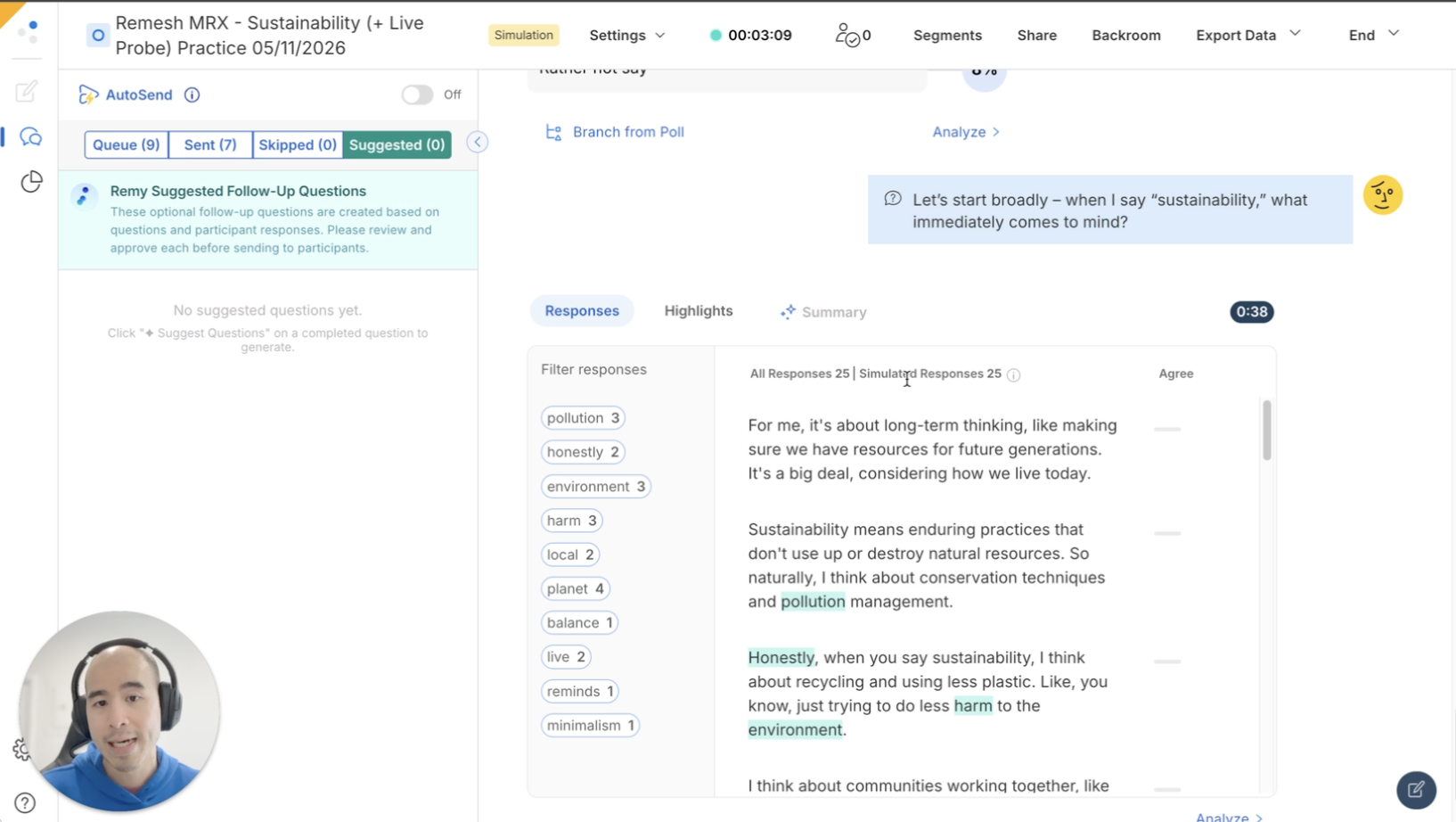
The three dialogues used Remesh, an AI-powered platform that poses questions to a live or asynchronous group, gathers open-text responses in the participants' own language, and uses participants' votes on each other's responses to reveal where a group agrees and disagrees, anonymously and quickly. In the proposed architecture, Remesh is one of the "fast feedback" tools (alongside other AI tools and conjoint survey analysis) intended to give negotiators a real-time read on public hopes, fears, and acceptance levels as talks proceed.
The three were deliberately different instruments. One was a live, multilingual and bicommunal process-design discussion tied directly to C-UP that focused on how negotiations could become more transparent, inclusive, durable, and effective. The second was a larger Greek-language "flex" (asynchronous) dialogue on perceptions of resolving the Cyprus problem from a wide spectrum of age groups of Greek Cypriots. The third was a smaller Greek-Cypriot monocommunal dialogue of undergraduate University of Cyprus students, understood throughout as reflecting that specific cohort, their needs and concerns not the Cypriot population which revealed big gaps in knowledge about both BBF and the Cyprus issue.
Anonymity was central and deliberate: where taking a public stance on the Cyprus problem carries social cost, an anonymised, vote-based format lets people express and endorse views they might not voice in a named room. That is precisely what makes divergence visible rather than suppressed — and what makes the feedback trustworthy for negotiators.
What emerged
Across the three, one pattern held: a strong appetite for a better process, no settled agreement on a specific outcome despite broad agreement of BBF.
In the C-UP process-design dialogue, participants converged clearly on concrete reforms. Public mapping of agreed points drew support from 81.8% of respondents to the relevant poll; staged confidence-building measures and a citizen-triggered Citizens' Council were each supported by 77.3%. People wanted transparency and structured citizen involvement designed into the process.
The larger perceptions dialogue showed the opposite on substance: sharp divergence across demographic and experiential segments, with polarisation clustering around sovereignty and natural resources, external guarantees and troop withdrawal, and whether dialogue is the only peaceful path.
The student dialogue is the most striking and the most carefully bounded. No response reached the 35% threshold Remesh uses to flag genuine cross-group agreement — meaning the cohort held no unified position at all. Rejection was clear: 74.5% rejected a two-state solution, but 71% also accepted a Bizonal, Bicommunal Federation (BBF), the agreed basis for talks. Open-ended responses returned repeatedly to the longstanding Cyprus problem, peace and security, reunification, and territorial readjustments but they also revealed a big gap of knowledge about both BBF and the Cyprus issue itself.
What it changed
The findings did not settle the substance of the Cyprus problem, and were never meant to. Their value was to test and validate a mechanism and to discipline the design of the civic track around what the public will actually bear.
First, the dialogues gave working proof that a fast-feedback tool can function across languages and surface both convergence and division in a divided society, the precondition for proposing it to negotiators at all. Second, the pattern reinforced a core design principle of the two-tier proposal: that an early assembly should focus on process, before substance. The broad, cross-cutting support for public mapping and citizen-triggered mechanisms shows where agreement is real; the polarisation on sovereignty and guarantees shows where it is not, and where an assembly asked to decide substance would fracture or be captured. Third, these results informed the writing up of a specific proposal for the establishment of a consultative body by members of the C-Up Technical Advisory Board (available here https://app.scoreforpeace.org/en/pub/633) that was almost in its entirety adopted by the leaders of the two communities. If the principal effect was on the team's confidence that a civic track is both wanted and workable, rather than on a single decision, the poll figures are how we know it, and that confidence is now feeding a model eventually agreed by both leadership teams. The newly formed Bicommunal Steering group also includes some members of the C-Up Technical Advisory Board
Limitations and safeguards
The exercises demonstrate potential, not representativeness. Two of the three were conducted only in Greek, and the student exercise involved a narrowly defined cohort. Future bi-communal applications should use transparent recruitment, balanced participation from both communities, appropriate sample sizes, equivalent Turkish and Greek materials, accessible participation options, independent facilitation and clear reporting of methods. They should also address digital exclusion, algorithmic transparency, data protection and the risk that simplified agreement scores obscure important differences within communities.
Acknowledgements and Quotes
CPDC thanks Remesh for providing complimentary access to the platform for exploratory testing.
The C-Up team also acknowledges opportunities for knowledge exchange with the United Nations in Cyprus on inclusive civic participation.
"The instinct in a divided society is to reach for the reassuring number. What this told us was more useful: where people genuinely agree, and where they don't. A process built on the first and honest about the second stands a better chance." [Advisory Council member]
"Running deliberation anonymously and across languages changes what people are willing to say. Views that would never surface in a named room appeared and were endorsed — that is the whole point of a feedback tool worth giving to negotiators." [Advisory Council member]
About C-Up
C-Up (Updated Cyprus Peace Process Design, 2025–2027) is an EU-funded bi-communal initiative led by the Cyprus Peace and Dialogue Center with ICLAIM. It pilots citizens' assemblies and structured deliberation as a complementary civic track to formal Cyprus peace negotiations — supporting the leaders rather than replacing them, and strengthening transparency, participation, and social cohesion.
-
Lorem ipsum dolor sit amet, consectetur adipiscing elit. Suspendisse varius enim in eros elementum tristique. Duis cursus, mi quis viverra ornare, eros dolor interdum nulla, ut commodo diam libero vitae erat. Aenean faucibus nibh et justo cursus id rutrum lorem imperdiet. Nunc ut sem vitae risus tristique posuere.
-
Lorem ipsum dolor sit amet, consectetur adipiscing elit. Suspendisse varius enim in eros elementum tristique. Duis cursus, mi quis viverra ornare, eros dolor interdum nulla, ut commodo diam libero vitae erat. Aenean faucibus nibh et justo cursus id rutrum lorem imperdiet. Nunc ut sem vitae risus tristique posuere.
-
More
Beyond Simplistic Analysis: Using Advanced Methods to Understand Complex Real-World Problems
Read More
Learn More
Stay up-to date.
Stay ahead of the curve. Get it all. Or get what suits you. Our 101 material is great if you’re used to working with an agency. Are you a seasoned pro? Sign up to receive just our advanced materials.


