




Advanced Research
Beyond Simplistic Analysis: Using Advanced Methods to Understand Complex Real-World Problems

.png)

.png)
Read Article

.png)
.png)

Team Remesh
September 16, 2026
Employee Research
Articles
Advanced Research
Beyond Simplistic Analysis: Using Advanced Methods to Understand Complex Real-World Problems
Learn More
Team Remesh
September 16, 2026
Employee Research
Articles
.png)
Advanced Research
What Really Drives Outcomes: Why key driver analysis needs more than one method
Read Article
Team Remesh
September 9, 2026
Employee Research
Articles
Advanced Research
What Really Drives Outcomes: Why key driver analysis needs more than one method
Learn More
Team Remesh
September 9, 2026
Employee Research
Articles
Advanced Research
From Question to Defensible Decision: 2026 at Remesh So Far
Read Article
Anthony Lam
September 9, 2026
Market Research
Articles
Advanced Research
From Question to Defensible Decision: 2026 at Remesh So Far
Learn More
Anthony Lam
September 9, 2026
Market Research
Articles

Advanced Research
When AI Makes Work Less Human
Read Article
Team Remesh
September 3, 2026
Employee Research
Articles
Advanced Research
When AI Makes Work Less Human
Learn More
Team Remesh
September 3, 2026
Employee Research
Articles
.png)
Advanced Research
Online Focus Group Platforms Compared: What Enterprise Insights Teams Should Evaluate
Read Article
Team Remesh
August 30, 2026
Market Research
Articles
Advanced Research
Online Focus Group Platforms Compared: What Enterprise Insights Teams Should Evaluate
Learn More
Team Remesh
August 30, 2026
Market Research
Articles
.png)
Advanced Research
Tracking Challenges Over Time: A Conversational Approach
Read Article
Team Remesh
August 26, 2026
Employee Research
Articles
Advanced Research
Tracking Challenges Over Time: A Conversational Approach
Learn More
Team Remesh
August 26, 2026
Employee Research
Articles
.png)
Advanced Research
Exploring Stakeholder Alignment: A Computational Mixed Methods Case Study
Read Article
Team Remesh
August 19, 2026
Employee Research
Articles
Advanced Research
Exploring Stakeholder Alignment: A Computational Mixed Methods Case Study
Learn More
Team Remesh
August 19, 2026
Employee Research
Articles
.png)
.png)
Beyond Simplistic Analysis: Using Advanced Methods to Understand Complex Real-World Problems
What AI adoption reveals about systems, configurations, and the human experience of change

Many of the most consequential challenges organizations face today are not merely complicated problems with discoverable right answers. They are complex and adaptive: conditions change as people respond to them, causes and consequences interact, and interventions alter the system they are intended to improve. In Kees Dorst’s terms, these are often open, complex, dynamic, and networked problems. The problem itself may need to be framed before it can be solved. Under those conditions, a single score, a ranked list of drivers, or even a well-executed thematic analysis can illuminate part of the landscape while still missing the structure of the problem.
If organizations are going to make better decisions in these environments, the analytical approach has to become richer as well. That does not mean making analysis complicated for its own sake. It means using advanced methods when the problem requires them: combining qualitative interpretation, relational and network analysis, statistical modeling, configurational analysis, and human judgment so that we can examine not only what matters, but how conditions connect, what works together, and how people experience the system as a whole.
AI adoption is a case in point. Organizations are simultaneously trying to build capability, establish governance, identify valuable use cases, integrate new tools into workflows, encourage experimentation, involve employees, and protect human agency. These are not independent implementation tasks. Training changes what people can do with AI. Governance changes whether experimentation feels legitimate or risky. Participation shapes whether implementation feels collaborative or imposed. Actual use changes what employees learn about the technology. Those experiences, in turn, are associated with whether AI is understood as augmentation, substitution, or something in between.
We explored this problem in the Remesh Rapid Research Lab using a mixed-method analysis of employee responses about AI integration at work. Rather than asking only which practices were most common or which variables had the strongest average relationships with outcomes, we asked a more systemic question: how do the elements of AI adoption connect across the same people and across different layers of experience? The resulting evidence does not establish a causal model or a universal maturity sequence. It supports something more useful for this kind of problem: a view of AI adoption as an interconnected sociotechnical system in which capability, governance, use, participation, workflow integration, and employees’ interpretations of AI operate in relation to one another.
From open-ended language to a relational map
The study included 155 respondents and combined closed-ended measures with several open-ended questions. Employees described what their organizations were doing well to support AI adoption, what could be improved, what support they needed as AI use increased, what they would prioritize if they were responsible for integration, and why they believed AI increased, reduced, or had little effect on employee autonomy and dignity. The open-ended responses were conservatively multi-coded into recurring concepts such as training and capability, governance and guidance, access to tools, workflow integration, use-case clarity, experimentation, employee involvement, privacy and security, efficiency, job security, human agency, and higher-value work.
We then represented those data as a bipartite network: one set of nodes represented respondents and the other represented concepts. A connection indicated that a respondent expressed a concept in a particular question layer. Projecting that network onto the concept side allowed us to examine which ideas were repeatedly connected through the same respondents, rather than simply counting how often each idea appeared. We retained the question layer in the node definition—so “training as something working” is analytically distinct from “training as support needed”—which made it possible to trace persistence and cross-layer relationships without pretending that every mention means the same thing.
That distinction matters. A frequency table might tell us that training is common. The network can show that training appears as a strength, an improvement opportunity, a support need, and an employee-set priority among overlapping groups of people. Seventeen respondents connected training as something already working with training as something that could improve; 26 connected training improvement with training support; and 30 connected training support with training as the priority they would set themselves. In the projected network, training/capability nodes were also among the strongest and most central. Capability is therefore not merely the most popular theme. It behaves like a backbone running through several layers of the adoption system.
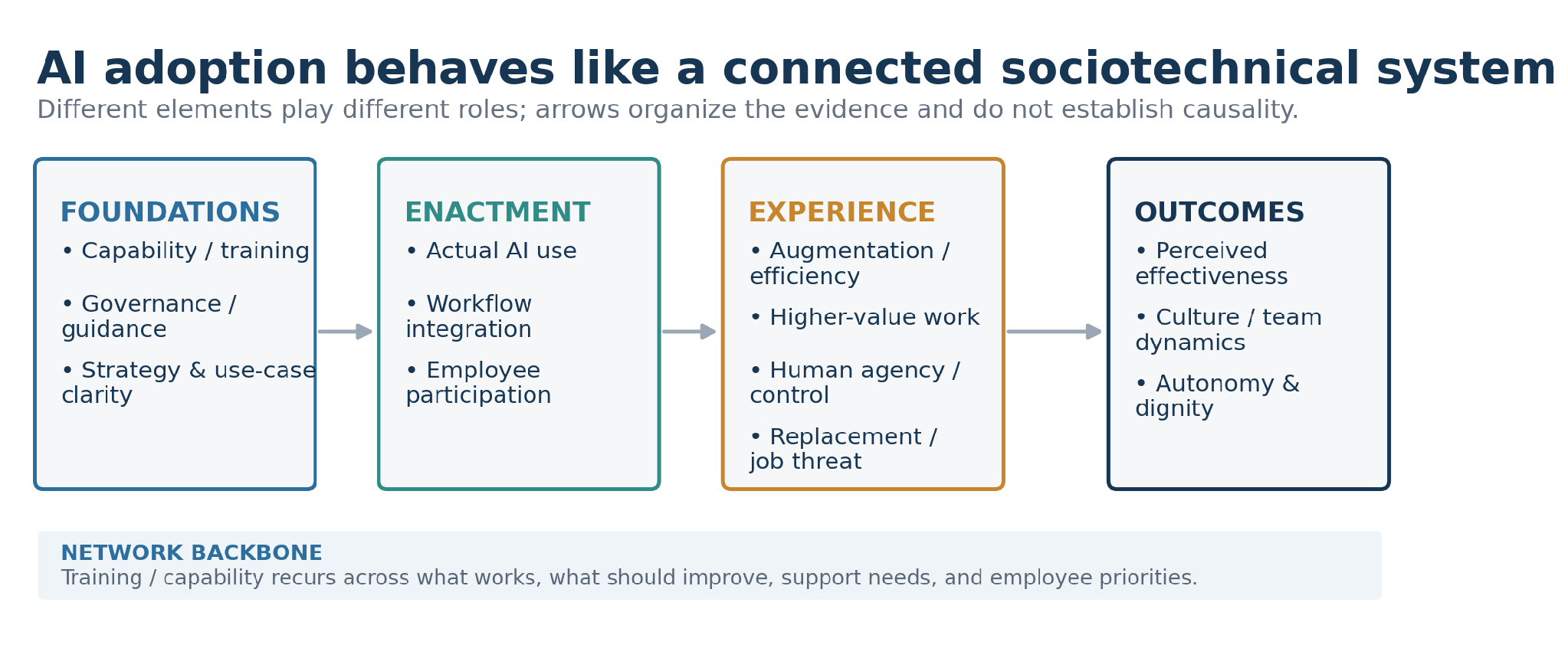
Figure 1. An evidence-organizing model derived from the combined network, closed-ended, and configurational analyses. The arrows structure the interpretation; the cross-sectional study does not establish causal ordering.
Different conditions appear to play different roles
The closed-ended evidence helps differentiate parts of the system. Frequent AI use showed the strongest adjusted relationship with perceived effectiveness. In a logistic challenge model that considered frequent use, integration maturity, clear governance, and high employee involvement simultaneously, frequent users had about 5.1 times the odds of rating AI integration as highly effective. High involvement also retained a meaningful relationship with effectiveness, at about 2.6 times the odds. These estimates should be read as comparative associations rather than causal effects, but they suggest that exposure and participation are not interchangeable with simply being farther along an implementation timeline.
For culture, the pattern changes. Clear, well-communicated governance was the strongest adjusted signal, associated with about 6.4 times the odds of a positive cultural assessment; high involvement was associated with about 3.7 times the odds. The raw differences tell the same story in more intuitive terms. Among respondents reporting clear governance, 94% described AI’s cultural impact positively, compared with 58% among those without that condition. Governance, in this dataset, looks less like a compliance afterthought than part of the social infrastructure surrounding adoption.
Autonomy and dignity reveal yet another pattern. High involvement was associated with roughly 3.5 times the odds of a positive autonomy response after the other implementation conditions were included; frequent use was associated with about 2.9 times the odds. Among employees actively helping shape implementation, 64% said AI increased autonomy and dignity and only 7% said it reduced them. Among employees not involved at all, only 16% reported increased autonomy while 58% reported a reduction. The data cannot tell us that participation caused those perceptions. They do, however, make a narrower and important point: participation is strongly entangled with the human meaning employees assign to AI implementation.
Configurations matter more than isolated ingredients
A systemic account should also ask whether conditions work in combination. We therefore conducted an exploratory crisp configurational analysis using four conditions available in the study: frequent AI use, mature integration, clear governance, and high employee involvement. In the truth table, each respondent is represented not by a single score but by a configuration of conditions. This is the central move in Qualitative Comparative Analysis (QCA): it shifts the question from “Which variable matters most?” to “What tends to be present together when an outcome occurs?”
For an accessible view of the pattern, Figure 2 groups respondents by the number of these four conditions present. A broad accumulation pattern is visible, although it is not uniform across outcomes. With one condition present, 18% described integration as highly effective, 48% reported a positive cultural impact, and 26% reported increased autonomy and dignity. With two conditions, the corresponding rates were 56%, 74%, and 28%. With three, they rose to 75%, 94%, and 63%. When all four conditions were present, 93% reported high effectiveness, 100% positive cultural impact, and 73% increased autonomy and dignity. Respondents with three or four conditions present generally reported more favorable outcomes than those with only one or two. The three outcomes are also substantively different—operational effectiveness, cultural experience, and human agency—which is one reason the identity and combination of conditions remain important.
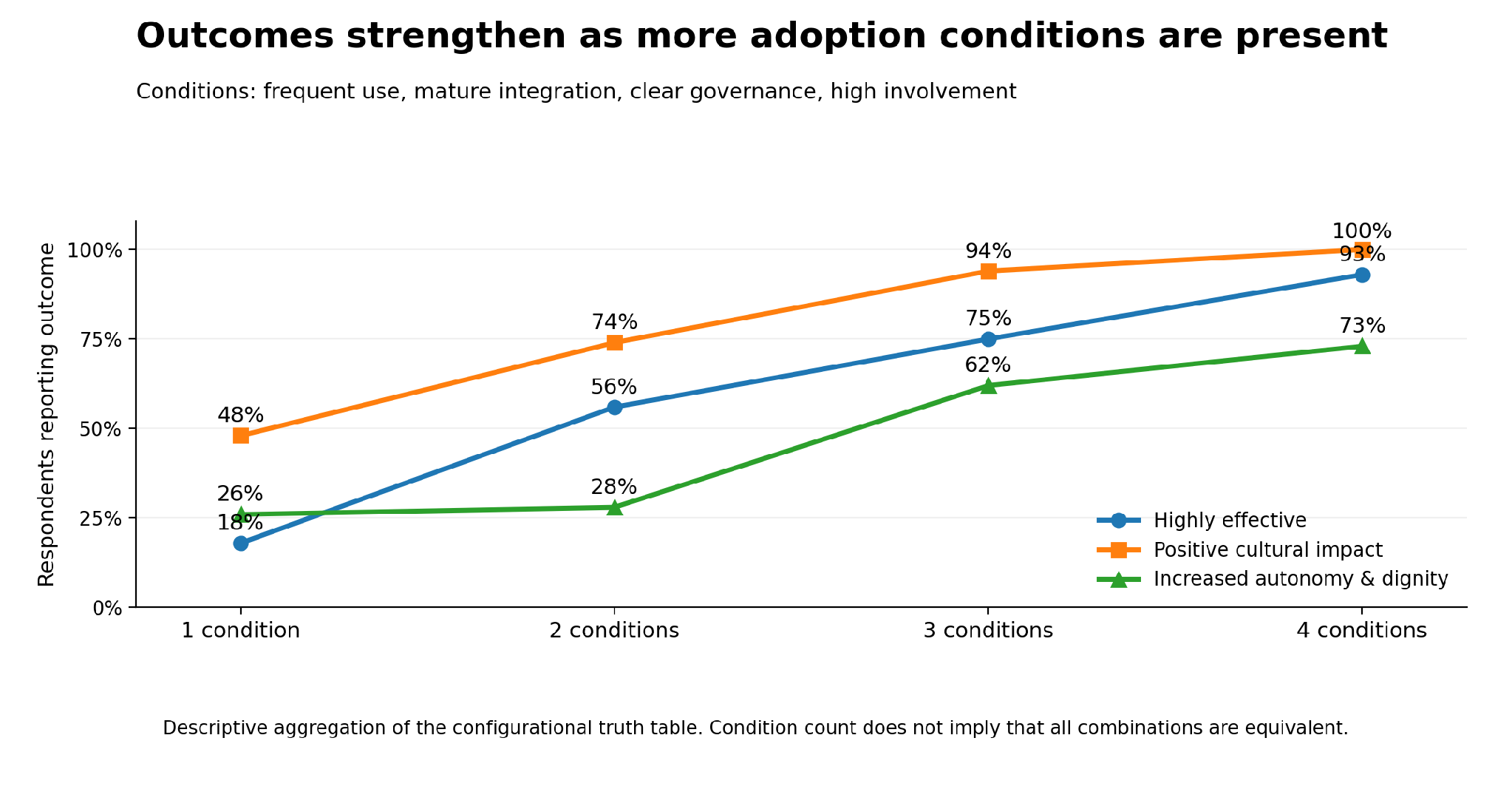
Figure 2. Descriptive aggregation of the configurational truth table. Percentages show the outcome rate among respondents with one, two, three, or all four adoption conditions present. This display makes the accumulation pattern easy to see, but it should not be mistaken for the QCA itself: configurational analysis also asks which specific conditions are present together, because two configurations containing the same number of conditions may behave differently. The results are exploratory and associational, not causal.
The human meaning of AI: augmentation or substitution
The open-ended explanations of autonomy and dignity add an interpretive layer that the network and closed-ended models cannot supply on their own. Among employees who said AI increased autonomy and dignity, the most common rationale was augmentation and efficiency: AI removed repetitive work, saved time, accelerated tasks, or created capacity for other activity. Higher-value or creative work also appeared disproportionately in the positive group. Across all respondents whose explanations explicitly referenced efficiency or time savings, 68% reported positive autonomy, compared with 25% among those who did not use that rationale.
The negative side of the experience is qualitatively different. Concerns about job security, replacement, human control, and capability loss also appeared in employees’ explanations of reduced autonomy and dignity. This does not establish that replacement anxiety causes diminished autonomy. It does show that the same technology can be incorporated into radically different interpretations of work: as a means of releasing capacity and extending agency, or as a signal that human contribution and control are becoming less secure.
That distinction helps explain why an adoption program can look technically successful while producing uneven human outcomes. Tool access alone does not determine whether AI is experienced as empowering. Nor does maturity by itself settle the question. What appears to matter is how technology is embedded in a broader system of capability, clarity, participation, workflow, and meaning.
What the network does—and does not—tell us
The projected concept network contained 64 recurring layer-specific concepts and 499 respondent-supported edges with a weight of at least two. Community separation was weak, with modularity of roughly .095. We therefore do not interpret the study as revealing several clean employee “types” or discrete adoption cultures. The more defensible interpretation is the opposite: the concepts form a densely connected field. Training connects with guidance, access, experimentation, use-case clarity, and workflow integration; employee priorities connect outward to efficiency, higher-value work, human agency, and job-security concerns. The network is useful because it preserves those relationships after the text has been coded.
It is equally important to say what this analysis cannot establish. The study is cross-sectional, so temporal and causal ordering cannot be inferred. Network edges represent respondent-level co-occurrence, not causal pathways. The qualitative coding is an analytical reduction of richer language, even though multi-label coding preserves more complexity than assigning each response to a single theme. Logistic estimates are challenge tests rather than causal models, and the configurational comparisons include some small cells. A stronger future design would repeat these measures over time, validate the coding with independent human review, and test whether changes in governance, participation, capability, and use precede changes in effectiveness, culture, or autonomy.
How we analyzed the system
No single technique was asked to carry the full explanatory burden. We used a sequence of complementary analyses because each answers a different question. The logic was cumulative: begin with employees’ own language, preserve relationships among concepts, challenge the emerging interpretation against closed-ended outcomes, test combinations of conditions, and then return to the source language to understand what the patterns mean.
First, we used conservative multi-label qualitative coding across five open-ended questions. A response could receive more than one concept when the language supported it, which matters because an employee can simultaneously describe training, access, uncertainty, and workflow friction. Coding necessarily reduces rich language, but multi-label coding avoids forcing each response into a single bucket and creates a transparent concept layer that can be checked against the original text.
Second, we constructed a respondent–concept bipartite network. In a bipartite network, two different kinds of entities are connected: here, people and the concepts appearing in their responses. We retained the question layer, so training mentioned as something already working remained distinct from training mentioned as a support need or employee priority. We then projected the network onto the concept side to examine which ideas were connected through the same respondents. This is what allowed us to move from “training is frequently mentioned” to the stronger observation that capability persists across multiple stages of the adoption experience and connects to other parts of the system.
Third, we used closed-ended association tests and multivariable logistic challenge models. Cramér’s V provided a scale-free view of the strength of relationships between implementation conditions and outcomes. The logistic models then considered frequent use, integration maturity, clear governance, and high involvement simultaneously. This does not turn a cross-sectional survey into a causal design. It does help challenge simple stories by asking whether a condition still distinguishes an outcome when the other measured conditions are considered at the same time.
Fourth, we used an exploratory crisp QCA-style configurational analysis. QCA treats the respondent as a case with a particular combination of conditions rather than decomposing the case into independent variables. We calibrated four conditions as present or absent—frequent use, mature integration, clear governance, and high involvement—and examined the truth table of observed combinations against three outcomes. This makes conjunction visible: a condition may matter because of what surrounds it. It also allows for equifinality, where more than one configuration can accompany the same outcome, and asymmetry, where the conditions associated with a positive outcome need not simply reverse when the outcome is absent. Figure 2 summarizes the accumulation pattern by number of conditions; the underlying configurational analysis retains the identity of the conditions as well as their count.
Finally, we returned to employees’ open-ended explanations of autonomy and dignity. This interpretive step matters because neither a network edge nor an odds ratio explains itself. The source language helped distinguish two qualitatively different ways AI was being experienced: as augmentation that can release time and support higher-value work, or as substitution and control that can threaten security, judgment, and agency. The methodological point is not that more methods automatically produce better research. It is that different methods preserve and test different features of the evidence—and, used together, can support a more systemic explanation.
This Is Why We Created the Rapid Research Lab
This is exactly why we created the Remesh Rapid Research Lab. Complex real-world organizational problems rarely arrive in a form that one analytical technique can fully explain. They involve language and numbers, individual experiences and system-level patterns, average relationships and distinctive configurations. The challenge is not simply to run more analyses. It is to assemble the right forms of evidence quickly enough to matter for real decisions, while preserving the rigor and judgment required to interpret complexity responsibly.
AI-powered analysis is central to that model, but not as an autonomous substitute for research expertise. Its value is analytical breadth, computational capacity, iteration, and speed: helping researchers structure large volumes of open-ended language, construct relational representations, examine alternative specifications, and move rapidly across methods that would traditionally require separate workflows. That acceleration creates room for deeper inquiry rather than forcing a tradeoff between speed and sophistication.
Advanced mixed methods provide the analytical architecture. In this study, qualitative coding established the concept system; bipartite analysis preserved respondent-level relationships among those concepts; association tests and multivariable models challenged simple interpretations; configurational analysis examined how conditions operated together; and a return to employees’ original language supplied meaning that no coefficient or network could provide on its own. Human expertise connects those methods—framing the problem, evaluating the coding and returning to source language, choosing defensible models and calibrations, testing rival interpretations, and deciding what the evidence does and does not warrant.
The Rapid Research Lab brings those three capabilities together: AI-powered analytical capacity, advanced mixed methods, and human research expertise. The goal is to solve complex problems and generate powerful insight at the speed of organizational decision-making—not by simplifying the problem until it fits one method, and not by treating AI output as analysis in itself, but by moving quickly among multiple ways of knowing and integrating them into a coherent explanation.
From adoption programs to adoption systems
The practical implication is not that organizations need a longer AI-adoption checklist. It may be that the checklist itself is the wrong unit of thought. Training without useful applications can become abstract. Access without governance can create uncertainty. Governance without participation can feel imposed. Mature integration without meaningful use can become infrastructure without value. And efficiency gains do not automatically translate into a better human experience if employees interpret the same technology as reducing control or threatening the value of their contribution.
A systemic perspective asks a different question: not simply whether each element is present, but how the elements work together and what kind of employee experience their configuration produces. In this study, the strongest outcomes appeared where frequent use, integration maturity, clear governance, and meaningful involvement came together. The qualitative evidence suggests that the human consequences may turn partly on whether those conditions allow employees to experience AI as augmentation rather than substitution.
That is the larger promise of relational analysis. Themes remain essential; they tell us what is present. But organizations are not collections of independent themes, and employees do not experience them one at a time. Bipartite and systemic analyses give us a way to preserve more of the structure between them. For AI adoption—where technology, work design, governance, participation, identity, and agency are unfolding together—that structure may be where some of the most consequential evidence lives.
Method note. Analysis based on 155 cross-sectional employee responses. Open-ended responses were conservatively multi-coded; bipartite respondent–concept networks were projected to examine co-occurrence and cross-layer persistence. Closed-ended relationships were examined with Cramér’s V and multivariable logistic challenge models. A crisp four-condition configurational analysis was used as an exploratory QCA-style comparison. All findings are associational and should not be interpreted as causal effects.
-
Lorem ipsum dolor sit amet, consectetur adipiscing elit. Suspendisse varius enim in eros elementum tristique. Duis cursus, mi quis viverra ornare, eros dolor interdum nulla, ut commodo diam libero vitae erat. Aenean faucibus nibh et justo cursus id rutrum lorem imperdiet. Nunc ut sem vitae risus tristique posuere.
-
Lorem ipsum dolor sit amet, consectetur adipiscing elit. Suspendisse varius enim in eros elementum tristique. Duis cursus, mi quis viverra ornare, eros dolor interdum nulla, ut commodo diam libero vitae erat. Aenean faucibus nibh et justo cursus id rutrum lorem imperdiet. Nunc ut sem vitae risus tristique posuere.
-
More
Stay up-to date.
Stay ahead of the curve. Get it all. Or get what suits you. Our 101 material is great if you’re used to working with an agency. Are you a seasoned pro? Sign up to receive just our advanced materials.


