



The Top Market Research Companies for the CPG Industry
The CPG industry is entering an AI-native era of market research. This guide breaks down the top market research companies serving CPG brands- how they use AI to scale insight generation, support better decision-making, and where each excels (or falls short) across innovation, tracking, and research complexity.
Team Remesh
January 21, 2026


In the CPG world, emotional sentiment is no longer just a data point. It’s a strategic differentiator.
The executives and researchers of leading brands are treating feelings as predictive drivers of loyalty, innovation, and growth. The top market research companies aren’t just counting likes or NPS—they’re measuring conflict and cultural context of target audiences. Something mere transactional data could never capture.
Thanks to advances in AI, the best CPG market research firms can now capture nuanced consumer feelings at a scale and depth previously unimaginable. The global emotion analytics market is proof, with predictions that the market will grow from $1.54 billion in 2026 to $18.81 billion by 2035.
According to a 2025 study by Harvard Business School, market researchers are successfully using Large Language Models (LLMs) like ChatGPT as synthetic focus groups to flag ideas likely to fail in-market in categories like toothbrush testing. Other researchers are turning to auto coding to organize and analyze consumer insights. On top of that, reporting from Food Navigator noted that grocery stores will shortly become one of the most transformative consumer data providers, with almost half of all grocery shoppers predicted to use AI by 2030.
With such unprecedented access to consumer purchasing data, the CPG industry is especially primed for a renaissance of data-driven business decisions and outcomes.
A Deep Dive Into AI Maturity for CPG Research
The landscape of market research from product development to brand strategy is no longer just AI-enhanced, but AI-native. From predicting human behavior to moderating thousands of live conversations simultaneously, it's simple to understand consumers with speed and scale.
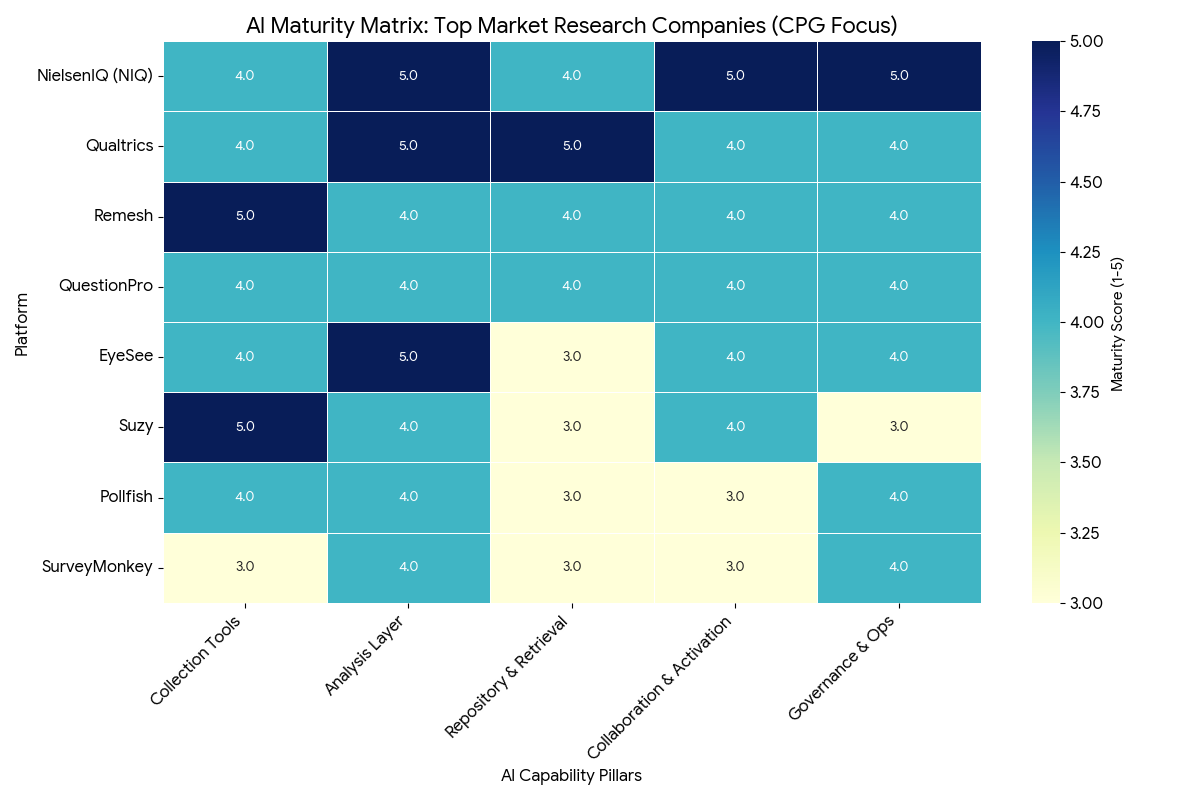
But not all AI is created equal, and not every research project is designed for the same purpose. In the chart below, learn how the top market research companies are leveraging AI to assist CPG brands — and where your research tech stack stands in the mix.
The AI Maturity Matrix for Market Research Companies
To understand how sophisticated various AI capabilities are across the market research industry — and for CPG brands specifically — Remesh developed an AI research maturity matrix. The matrix methodology is a weighted 1 to 5 quantitative approach evaluating companies on their performance in five categories. A scoring on the low end (equaling 1) of the scale indicates the performance in a category is poor, whereas a scoring on the high end (equaling 5) of the category indicates performance is industry-leading. A score in the middle of the scale (equaling 3) indicates as-expected performance. This methodology provides nuance when it comes to evaluating a company’s fit for a CPG consumer insights project, rather than indicating performance overall.
Use the matrix below to evaluate the capabilities of nine leading market research companies: Qualtrics, Remesh, Ipsos (Facto), NielsenIQ (NIQ), Suzy, QuestionPro, SurveyMonkey, EyeSee, and Pollfish. Remesh’s proprietary maturity model covers the performance of these market research companies across five key pillars:
- Collection Tools: How effectively they gather data using AI-first methods.
- Analysis Layer: The sophistication of their AI for pattern detection and synthesis.
- Repository & Retrieval: Their ability to store, search, and leverage past insights.
- Collaboration & Activation: How AI facilitates sharing and acting on insights.
- Governance & Ops: Their commitment to AI transparency, privacy, and workflow integrity.
NielsenIQ (NIQ): AI Maturity Score Overview (Average: 4.6)
- Collection Tools: 4
- Analysis Layer: 5
- Repository & Retrieval: 4
- Collaboration & Activation: 5
- Governance & Ops: 5
NielsenIQ has AI deeply embedded across its platforms. Its can process vast swathes of retail data, predict market shifts, and offer prescriptive actions for brands and retailers.
Strengths:
- Leading Analysis Layer: NIQ's AI processes point-of-sale data, consumer panel information, and media consumption to predict market trends, optimize assortment, and model promotional effectiveness.
- Robust Repository & Retrieval: Their extensive historical data sets – spanning decades of retail and consumer behavior – are AI-tagged and indexed.
- Strong Governance & Ops: Handling highly sensitive sales and consumer data, NIQ maintains rigorous AI governance, auditability, and privacy protocols.
Weaknesses:
- Collection Focus: While robust, NIQ's collection strengths are more in passive data acquisition (retail scanner data, behavioral panels) rather than active, AI-moderated qualitative collection.
- Customization for Qualitative Nuance: While good at quantitative pattern recognition, its AI data analytics may not delve into the same depth of granular qualitative nuance as platforms specifically designed for AI-first qualitative collection.
Qualtrics: AI Maturity Score Overview (Average: 4.4)
- Collection Tools: 4
- Analysis Layer: 5
- Repository & Retrieval: 5
- Collaboration & Activation: 4
- Governance & Ops: 4
Qualtrics integrates AI across every touchpoint of the customer journey. This is a good solution for enterprises seeking an end-to-end solution where AI acts as the connective tissue and manages everything from operational data to deep qualitative insights, and operates within a governed and scalable environment.
Strengths:
- Analysis Layer: Qualtrics' AI excels in predictive analytics, sentiment analysis, and automatically identifying "Experience Gaps."
- Robust Repository & Retrieval: The XM/os acts as a unified knowledge graph, automatically tagging every piece of feedback, interaction, and research.
- Strong Governance & Ops: Qualtrics offers robust consent management, data privacy features, and audit trails for AI-generated insights.
Weaknesses:
- Complexity & Onboarding: While powerful, the sheer breadth and depth of the Qualtrics platform can lead to a steep learning curve for new users.
- Cost: Qualtrics' AI capabilities come with a significant investment.
- Customization for Niche AI: Specific niche AI functionalities may require integrations rather than being native to the platform.
Remesh: AI Maturity Score Overview (Average: 4.0)
- Collection Tools: 5
- Analysis Layer: 4
- Repository & Retrieval: 4
- Collaboration & Activation: 4
- Governance & Ops: 4
Remesh turns small, intimate discussions into large-scale, AI-moderated conversations. Researchers use the platform’s AI-first, live qualitative feedback collection to engage with thousands of participants simultaneously, extracting rich, thematic insights in real-time.
Remesh is the go-to platform for anyone needing to conduct agile, large-scale qualitative research, rapidly test hypotheses with diverse groups, or inject real-time human feedback into decision-making processes.
Strengths:
- Collection Tools: Remesh AI can moderate discussions, and identifies themes as participants type. This allows for unprecedented speed and scale in qualitative data gathering.
- Strong Analysis Layer for Thematic Synthesis: Researchers can quickly identify consensus, divergence, and emerging ideas from vast amounts of qualitative data.
- Efficient Collaboration & Activation: Heatmaps of opinions and key themes makes sharing insights with stakeholders efficient and impactful.
Weaknesses:
- Specialized Focus: While exceptional in live, large-scale qualitative, Remesh's focus is narrower compared to broader experience platforms like Qualtrics.
- Repository & Retrieval: Remesh's primary strength is real-time processing and immediate insight generation. Its cross-project pattern is not as comprehensive as solutions like Qualtrics or Ipsos.
- Governance & Ops for Broader Scope: Remesh is Soc2 and GDPR compliant. Remesh also complies with the EU-U.S. Data Privacy Framework (EU-U.S. DPF), the UK Extension to the EU-U.S. DPF, and the Swiss-U.S. Data Privacy Framework (Swiss-U.S. DPF). While robust for its specific use case, its governance features are tailored to live qualitative data.
QuestionPro: AI Maturity Score Overview (Average: 4.0)
- Collection Tools: 4
- Analysis Layer: 4
- Repository & Retrieval: 4
- Collaboration & Activation: 4
- Governance & Ops: 4
QuestionPro offers a blend of survey and CX tools. QuestionPro is a good choice for research teams seeking a versatile, AI-enhanced platform with a strength in insight management and data analysis.
Strengths:
- Strong Repository & Retrieval: QuestionPro's uses AI to organize, tag, and make research findings highly searchable across projects. It acts as a centralized knowledge graph, allowing users to track longitudinal patterns.
- Solid Analysis Layer: QuestionPro provides advanced sentiment analysis using AI assistance with thematic analysis and statistical interpretation.
- Effective Collection Tools: The platform leverages AI for intelligent survey design, suggesting optimal question types and ensuring survey flow.
- Good Collaboration & Activation: QuestionPro offers shared AI workspaces and tools that assist in generating reports and executive summaries.
Weaknesses:
- AI-First Qualitative Scale: While offering conversational AI, its ability to manage and synthesize thousands of live qualitative responses in real-time may not match the specialized scale of platforms like Remesh.
- Behavioral Prediction: QuestionPro's AI capabilities are more focused on explicit feedback and text analysis rather than predictive behavioral analytics.
- Enterprise AI Customization: The level of deep, bespoke AI model training and secure sandbox environments might not be as extensive as the offerings from Ipsos Facto or Qualtrics.
EyeSee: AI Maturity Score Overview (Average: 4.0)
- Collection Tools: 4
- Analysis Layer: 5
- Repository & Retrieval: 3
- Collaboration & Activation: 4
- Governance & Ops: 4
EyeSee is a highly specialized platform, particularly in the realm of eye-tracking and emotional response. It provides deep, implicit insights into consumer attention and emotion without the need for expensive hardware.
Strengths:
- Exceptional Analysis Layer: EyeSee's algorithms can predict where a person will look on an image or video, generate heatmaps, and score attention areas with high accuracy, all without actual eye-tracking hardware.
- Innovative Collection Tools: The AI-driven predictive models act as a form of "collection," inferring behavioral data (like attention and emotional response via facial coding) from standard webcams or even just static images.
- Deep Implicit Insights: EyeSee excels at uncovering what consumers feel or see subconsciously, complementing explicit survey data with powerful behavioral metrics.
Weaknesses:
- Niche Focus: EyeSee is not designed to be an all-in-one survey platform or a comprehensive insight repository.
- Limited Repository & Retrieval: As a specialized tool, its repository functions are geared towards storing and analyzing its specific behavioral data.
- Collaboration & Activation for Broader Scope: Integrating these deep behavioral insights into broader marketing dashboards or complex CX journeys might require more manual effort or specific integrations compared to more generalized platforms.
- No Traditional Survey Capabilities: Researchers would still need a separate platform for traditional quantitative or qualitative data collection that relies on explicit feedback.
Suzy: AI Maturity Score Overview (Average: 3.8)
- Collection Tools: 5
- Analysis Layer: 4
- Repository & Retrieval: 3
- Collaboration & Activation: 4
- Governance & Ops: 3
Suzy prioritizes speed and agility, making it easier for brands to conduct rapid qualitative and quantitative surveys. Suzy is a good choice for brands and product teams that want to quickly turn questions into actionable data.
Strengths:
- Exceptional Collection Tools: Suzy is built for rapid survey deployment and real-time polling, making it agile for quick-turnaround insights.
- Strong Analysis Layer: Suzy's AI delivers robust sentiment analysis and automated thematic grouping of open-ended responses.
- Efficient Collaboration & Activation: The platform uses AI assistance to summarize findings and generate actionable reports.
- AI-Driven Fraud Detection: Suzy's AI ensures data quality by detecting and flagging fraudulent respondents or bots.
Weaknesses:
- Repository & Retrieval Depth: Suzy's strength is in new data generation. Cross-project historical retrieval is not as comprehensive as in enterprise platforms.
- Governance & Ops Breadth: It’s overall governance framework may not offer the same depth of auditability as more heavily regulated companies.
- Behavioral Predictive Limitations: Compared to specialists like EyeSee, Suzy's core AI isn't focused on hardware-free behavioral prediction (e.g., eye-tracking).
Pollfish: AI Maturity Score Overview (Average: 3.6)
- Collection Tools: 4
- Analysis Layer: 4
- Repository & Retrieval: 3
- Collaboration & Activation: 3
- Governance & Ops: 4
Pollfish delivers rapid, mobile-first surveys to a global audience. It focuses on speed and quality with capabilities for global audiences.
Strengths:
- Strong Governance & Ops: Pollfish excels in using AI for real-time fraud and bot detection. Its AI algorithms are constantly working to ensure data quality and deliver trustworthy responses.
- Agile Collection Tools: Its AI optimizes survey delivery and targeting to ensure rapid response rates, making it highly effective for quick-turnaround polling.
- Cost-Effective Speed: Pollfish provides a cost-effective solution for fast data collection, leveraging its AI to streamline the entire sampling and fielding process.
Weaknesses:
- Limited Analysis Layer Depth: While offering basic data visualization and cross-tabulation, Pollfish's core AI is less focused on deep thematic analysis, predictive modeling, or complex statistical interpretation.
- Basic Repository & Retrieval: Its repository functions are minimal.
- Collaboration & Activation: While data is easy to access, its AI does not offer advanced co-writing, stakeholder portals, or automated highlight reels.
- AI-First Qualitative Limitations: Pollfish's AI is not designed for AI-moderated live conversations or adaptive qualitative interviews.
SurveyMonkey: AI Maturity Score Overview (Average: 3.4)
- Collection Tools: 3
- Analysis Layer: 4
- Repository & Retrieval: 3
- Collaboration & Activation: 3
- Governance & Ops: 4
SurveyMonkey offers SurveyMonkey Genius for researchers interested in AI-enabled tech. This is a good choice for quick, efficient, and accessible feedback collection. Its AI capabilities are geared towards making the survey process smarter and the insights more digestible for a wide audience.
Strengths:
- Accessible Analysis Layer: SurveyMonkey Genius utilizes AI to automatically identify key trends, conduct basic sentiment analysis, and provide automated summaries of open-ended responses, making data interpretation accessible even for non-researchers.
- Strong Governance & Ops: Despite its broad accessibility, SurveyMonkey maintains robust data privacy and security features, with AI assisting in detecting survey fraud and ensuring data integrity, especially important given its massive user base.
- AI-Assisted Collection Tools: The platform uses AI to help users build better surveys faster, suggesting optimal question wording, detecting bias, and recommending question types to improve data quality from the outset.
- Streamlined Collaboration & Activation: AI features assist in drafting reports and generating executive summaries, making it easier for users to share insights quickly with stakeholders.
Weaknesses:
- Repository & Retrieval Depth: SurveyMonkey's primary strength is in current project execution. While it allows for data export, its native capabilities for a deep, AI-powered insight repository with cross-project pattern detection are not as advanced as specialized platforms.
- Limited AI-First Qual: While supporting open-ended questions, its AI doesn't extend to live, AI-moderated conversations or adaptive conversational interviews at the scale or sophistication of Remesh or Suzy.
- Behavioral Predictive Analytics: The platform's AI is less focused on advanced behavioral prediction or neuro-analytics (like EyeSee), primarily dealing with explicit stated feedback rather than implicit responses.
- Enterprise Integration: While offering enterprise plans, its AI capabilities might not integrate as deeply or offer the same level of customization for complex, bespoke enterprise workflows as platforms like Qualtrics or Ipsos.
Choosing the Right Market Research Company for Your CPG Brand
Start by clarifying objectives, timelines, and decisions you must make. Then, map providers to needs. Consider speed to insight, depth (qualitative vs. quantitative research), global reach, cost‑effectiveness, the need for a full service market researcher versus a project manager, and tech integration. For an agile market research process, define must‑haves, shortlist 3 to 5 vendors, and run a pilot.
Take Your Research Further
Discover how Remesh's AI-powered research platform can transform your understanding of customers, markets, and opportunities in the industry.
Request a demo and see how leading CPG brands are conducting research that combines qualitative depth with quantitative scale.
-
Lorem ipsum dolor sit amet, consectetur adipiscing elit. Suspendisse varius enim in eros elementum tristique. Duis cursus, mi quis viverra ornare, eros dolor interdum nulla, ut commodo diam libero vitae erat. Aenean faucibus nibh et justo cursus id rutrum lorem imperdiet. Nunc ut sem vitae risus tristique posuere.
-
Lorem ipsum dolor sit amet, consectetur adipiscing elit. Suspendisse varius enim in eros elementum tristique. Duis cursus, mi quis viverra ornare, eros dolor interdum nulla, ut commodo diam libero vitae erat. Aenean faucibus nibh et justo cursus id rutrum lorem imperdiet. Nunc ut sem vitae risus tristique posuere.
-
.png)
.png)
.png)


