



.png)
Advanced Research
Scaling Up Civic Participation: How Remesh Can Bring Cypriot Voices into the Peace Process

.png)

.png)
Read Article

.png)
.png)

Professor Charis Psaltis, University of Cyprus Member of C-Up Technical Advisory Board ; Dr Meltem Onurkan-Samani, Founder and Director of CPDC C-Up Lead Professor; Neophytos Loizides, University of Warwick Member of C-Up Technical Advisory Board
September 23, 2026
Market Research
Articles
Advanced Research
Scaling Up Civic Participation: How Remesh Can Bring Cypriot Voices into the Peace Process
Learn More
Professor Charis Psaltis, University of Cyprus Member of C-Up Technical Advisory Board ; Dr Meltem Onurkan-Samani, Founder and Director of CPDC C-Up Lead Professor; Neophytos Loizides, University of Warwick Member of C-Up Technical Advisory Board
September 23, 2026
Market Research
Articles
.png)
Advanced Research
What Tools Do Consultants Use to Run Employee Listening for Clients?
Read Article
Team Remesh
September 23, 2026
Employee Research
Articles
Advanced Research
What Tools Do Consultants Use to Run Employee Listening for Clients?
Learn More
Team Remesh
September 23, 2026
Employee Research
Articles
.png)
Advanced Research
50 Employee Benefits Survey Questions to Ask Before Open Enrollment
Read Article
Team Remesh
September 18, 2026
Employee Research
Articles
Advanced Research
50 Employee Benefits Survey Questions to Ask Before Open Enrollment
Learn More
Team Remesh
September 18, 2026
Employee Research
Articles

Advanced Research
Beyond Simplistic Analysis: Using Advanced Methods to Understand Complex Real-World Problems
Read Article
Team Remesh
September 16, 2026
Employee Research
Articles
Advanced Research
Beyond Simplistic Analysis: Using Advanced Methods to Understand Complex Real-World Problems
Learn More
Team Remesh
September 16, 2026
Employee Research
Articles
.png)
Advanced Research
What Really Drives Outcomes: Why key driver analysis needs more than one method
Read Article
Team Remesh
September 9, 2026
Employee Research
Articles
Advanced Research
What Really Drives Outcomes: Why key driver analysis needs more than one method
Learn More
Team Remesh
September 9, 2026
Employee Research
Articles
Advanced Research
From Question to Defensible Decision: 2026 at Remesh So Far
Read Article
Anthony Lam
September 9, 2026
Market Research
Articles
Advanced Research
From Question to Defensible Decision: 2026 at Remesh So Far
Learn More
Anthony Lam
September 9, 2026
Market Research
Articles

Advanced Research
When AI Makes Work Less Human
Read Article
Team Remesh
September 3, 2026
Employee Research
Articles
Advanced Research
When AI Makes Work Less Human
Learn More
Team Remesh
September 3, 2026
Employee Research
Articles
.png)
Advanced Research
Online Focus Group Platforms Compared: What Enterprise Insights Teams Should Evaluate
Read Article
Team Remesh
August 30, 2026
Market Research
Articles
Advanced Research
Online Focus Group Platforms Compared: What Enterprise Insights Teams Should Evaluate
Learn More
Team Remesh
August 30, 2026
Market Research
Articles
.png)
64 AI Market Research Prompts for Data Analysis
From concept testing to data analysis, use these prompts to bolster your market research.


AI is transforming how research gets done by giving researchers more ways to quickly explore their data and make strategic decisions. With prompts becoming an essential part of a researcher’s data analysis workflow, a researcher’s skill set now draws even more value from knowing what to ask, when to ask it, and how to structure it. The right prompts turn raw transcripts into insights, open-ended responses into themes, and datasets into actionable strategies.
Below, you’ll find 64 ready-to-use AI prompts, carefully organized by research type — from exploratory analysis and segmentation to bias auditing and executive reporting. Whether you’re analyzing open-ended responses, synthesizing transcripts, testing concepts, or preparing strategic summaries, these prompts are designed to help you think deeper, move faster, and deliver sharper recommendations.
What Makes a Prompt Comprehensive?
A great prompt does more than ask a question — it guides AI to think like a human insights strategist. It frames the objective, specifies what to evaluate, and requests structured outputs such as tables, scorecards, or segment breakdowns. The best market research prompts also account for uncertainty and risk, providing confidence levels and actionable recommendations.
In recent findings from Remesh researchers who analyzed thousands of interactions across the insights platform, one common method of prompting emerged: Your first question is a starting point, not the destination.
“When we examined how people asked their questions, a consistent rhythm emerged,” one researcher said. “Nearly half of all question behavior fell into two complementary modes: broad framing (‘What’s going on with this topic?’) and targeted evidence extraction (‘Show me quotes that support this.’).”
This is referred to as the frame-and-prove rhythm. A researcher orients to the data and establishes a baseline, then shifts into extraction by pulling specific quotes, counts, or distributions. They then return to framing, re-scoping or pivoting to a new angle — and the cycle repeats.
Pre-Study: Project Planning & Questionnaire Prompts
From project planning and questionnaire design to post-study analysis and executive reporting, the following prompt collection will help you turn data into insight and insight into action — whether you’re planning your study or extracting data and insights from it.
Before conducting any research, thorough pre-study planning is essential to ensure that your study design, survey questions, and data collection methods are well thought out. This stage helps prevent common mistakes, reduces bias, and improves the overall quality of the insights you gather. The following sections provide guidance on using ChatGPT or other AI chatbots to refine your research objectives and design before launching your study.
Research design & objectives
- Poke holes in my current research objectives for a study on [topic].
- Point to existing studies with similar hypotheses to mine for a consumer survey about [product/concept]. How does my hypothesis or study differ?
- What other type of study design would be most appropriate to investigate [research question]?
- List potential independent and dependent variables for a study on [topic].
Questionnaire development
- Create a list of survey questions to measure [concept], including Likert scales and open-ended items, that I haven 't thought of yet.
- What are common pitfalls in survey/focus group questions for [topic]?
- Help me draft demographic questions that are relevant to [target audience].
Sampling & recruitment
- What sampling methods are best for reaching [target population]?
- List strategies to recruit participants for a [online/in-person] survey/focus group.
Data collection planning
- Suggest ways to ensure high response rates and reduce attrition when conducting consumer surveys.
- Identify ethical considerations I should address before conducting this consumer study.
Analysis planning
- What statistical tests are appropriate for analyzing [type of data] from [type of survey]?
- How can I segment responses by demographic factors for deeper insights?
Bias & validity check
- What are common sources of bias in research methods about [topic] and how can I mitigate them?
- Review this set of survey questions and suggest improvements for clarity and neutrality.
Post-Study: Prompts for Analysis & Synthesis
Once your research study is complete, the focus shifts from data collection to analysis, interpretation, and actionable insight generation. This stage involves making sense of both quantitative and qualitative responses, uncovering patterns, and identifying the key drivers, barriers, and opportunities within your data.
The prompts in this section are designed to guide ChatGPT or other AI chatbots in helping researchers extract themes, evaluate concepts, and translate feedback into recommendations. By leveraging these prompts, you can efficiently summarize complex datasets, highlight areas of tension or opportunity, and provide clear, structured insights for decision-making.
These prompts cover a wide range of applications, from consumer sentiment and feature prioritization to concept testing, brand positioning, pricing perception, and claims evaluation.
Foundational & Exploratory Research
These prompts help synthesize qualitative data into consumer personas and common behavioral patterns. They can help uncover motivations, barriers, and emotional context that guide strategic decisions and hypothesis generation.
Segment differences
- Segment respondents based on demographics, behavior, or attitudes. Summarize my qualitative responses by creating mini personas that illustrate common behaviors, motivations, and barriers. Include representative quotes, emotional context, and notable variations between respondents.
Sentiment & emotion tracking
- Analyze the text of the survey responses for sentiment and emotion. Assign sentiment (positive/negative/neutral) and emotional labels (e.g., joy, frustration, trust, surprise) to each response. Summarize patterns across themes or segments and provide a table with sentiment, emotion, frequency, and key quotes.
Contrasting extreme respondents
- Identify the most enthusiastic and most critical respondents in this data. Summarize their feedback separately, highlighting extreme opinions, motivations, and concerns.
Co-creation & idea mapping
- Analyze these qualitative responses for suggestions, ideas, or improvements. Map those items into clusters of related concepts, highlighting the most common or unique ideas.
Executive summary
- Provide a high-level overview highlighting key findings, major trends, and notable surprises in the data.
Product Ideation & Development
These prompts cover theme extraction, feature prioritization, adoption modeling, brand preference, and usage behavior. They can support researchers in identifying which product attributes drive interest, adoption likelihood, and competitive advantage.
Theme extraction
- Identify themes where opinions are divided or contradictory, and flag areas of tension or opportunity.
Feature prioritization
- Analyze the survey responses/open-ended feedback on proposed features. Rank each feature by desirability, perceived usefulness, and potential adoption impact. Highlight features that drive excitement versus those that may cause hesitation.
Adoption modeling & trial likelihood
- Using survey data on likelihood-to-try, segment respondents into the following groups: Innovators, Early Adopters, Fence-Sitters, and Rejectors. Identify barriers to adoption for each group.
Brand preference ranking
- Analyze questions on brand preference and rank. Identify the top drivers of preference (e.g., quality, trust, price, familiarity) and cluster them into themes.
Usage & purchase behavior
- Analyze responses in regard to how often and when consumers use a product. Segment by frequency, purchase location, and usage pattern.
Thematic heatmaps
- Analyze the qualitative responses and identify recurring themes, topics, and emotional tones. Create a heatmap-style table showing the frequency or intensity of each theme across different respondent segments (e.g., age, usage frequency, or brand preference).
Ad & Creative Testing
These prompts help analyze comprehension, brand fit, attention, recall, and risk in advertising and creative assets — all of which are critical for optimizing messaging, visuals, and brand alignment before launching campaigns.
Message & concept clarity
- Analyze the ad to determine whether the key message is understood by consumers. Identify which elements (visual, copy, tone) enhance or hinder comprehension.
Brand fit & association
- Evaluate how well the ad aligns with the brand's identity and positioning. Identify if the ad strengthens or dilutes brand associations, and highlight any potential confusion with competitors.
Attention & recall
- Analyze which elements of the ad (headline, visuals, call-to-action) are most noticeable and memorable to consumers.
Risk areas
- Identify features, messages, or aspects of the concept that may cause confusion, negative perception, or low engagement.
Concept Development
When it comes to concept development, specific prompts can help researchers evaluate comprehension, uniqueness, differentiation, and brand fit of new concepts. This ensures ideas are clearly understood, stand out in the market, and align with brand credibility.
Understanding & clarity
- Analyze responses about comprehension and clarity of the concept. Identify which parts are well understood and which are confusing.
Uniqueness & differentiation
- Analyze responses about how unique or distinctive the concept is compared to competitors. Identify similarities with existing products, perceived originality, and ways to make the concept more memorable.
Brand fit & credibility
- Analyze responses about brand alignment and credibility. Identify whether the concept fits with the brand image, feels believable, and aligns with consumer expectations.
Package Testing
Prompts can be used in package testing to assess label clarity, regulatory understanding, and potential misinterpretation risks. Focusing here can ensure that packaging communicates information accurately, prevents confusion, and avoids compliance or perception issues.
Trust & perception
- Which features of the packaging influence perceived quality or trustworthiness?
Customer themes
- Can you identify clusters of consumers with similar perceptions of the packaging?
Label clarity & regulatory understanding
- Evaluate whether all necessary information (nutrition, instructions, claims, warnings) is clear and understandable. Identify confusing or overlooked labels.
Risk & misinterpretation assessment
- Identify potential risks, such as misinterpretation of claims, offensive design, or misleading visuals.
Concept Test Diagnostic Prompts
Diagnostic prompts can identify structural weaknesses, messaging gaps, competitive overlap, and adoption potential. This is important for refining early concepts to increase trial intent, emotional resonance, and overall market fit.
Structural weakness identification
- Act as a senior insights strategist. Analyze the feedback on this concept and evaluate it across the following dimensions: relevance, uniqueness, credibility, emotional resonance, and trial intent.
Messaging refinement
- Review the concept feedback and standout words/phrases mentioned by respondents.
Competitive overlap assessment
- Using the concept and any mentions of competitor brands, evaluate where the concept overlaps with existing offerings in the category.
Adoption modeling
- Estimate trial elasticity: which single change or improvement would most increase adoption rates?
Driver analysis
- Identify the key motivators and barriers for each segment, and provide illustrative quotes for each driver.
Usage & category behavior
- Analyze the responses to "How often do you use [TOPIC] in your daily life?" Identify usage patterns, segment respondents by frequency (e.g., frequent, moderate, infrequent, non-users), and highlight any trends or outliers.
Compelling words & visuals
- Extract the most compelling words, phrases, and image elements mentioned by respondents. Identify patterns in language that resonate with consumers, and highlight visual components that attract attention or create confusion.
Concept comparison & choice drivers
- Identify key differentiators driving preference for each concept. Then, create a table illustrating the data with the following columns: concept, rank, reasons for preference, and supporting quotes.
Brand Positioning, Messaging, & Equity Prompts
These types of prompts can extract brand attributes, map emotional territory, and identify white space opportunities. Using these can strengthen brand positioning, help differentiate messaging from competitors, and avoid brand equity risks.
Brand attribute extraction
- From open-ended mentions of [BRAND], extract all traits or associations that consumers spontaneously recall. Rank them by salience or frequency, and highlight which attributes are unique versus commonly shared in the category.
Emotional territory mapping
- Create a visual-style emotional map showing how consumers feel about the brand versus competitors. Highlight clusters of emotional opportunity that are under-leveraged by competitors.
Competitive positioning
- From open-ended feedback, extract language or claims used for [BRAND] and competitors. Highlight which messaging reinforces positioning and which dilutes it.
White space identification
- Analyze this dataset and identify attributes or benefits that consumers rate as highly important but perceive as poorly delivered by current brands.
Equity transfer risk analysis
- Analyze consumer reactions to concepts leveraging [BRAND] equity. Highlight instances where equity transfer could weaken trust, reduce credibility, or conflict with core positioning.
Main Message Takeaway
- Analyze responses to "What"s the main message you take away from this statement?" Identify whether the intended message is accurately perceived, partially understood, or misinterpreted.
Pricing & Value Perception Prompts
These prompts help researchers evaluate perceived value, price sensitivity, and premium vs. discount signals. In the long-term, the data analyzed here can help inform pricing strategies, positioning, and trade-off decisions for maximizing adoption and revenue.
- Researchers often ask for structured pricing insight. Often includes:
Value-for-money themes
- Identify trade-offs consumers mention between price and benefits/features. Highlight which aspects drive perceptions of value for money.
Premium vs discount signals
- Identify language or descriptors in open-ended responses that signal a desire for premium quality or discount value.
Price resistance triggers
- Extract common objections or concerns related to price. Cluster them into categories such as "too expensive," "not worth features," "prefer competitor pricing."
Segment-level price sensitivity
- Compare segments to identify opportunities for tiered pricing, premium offerings, or targeted discounts.
Claims and Reason to Believe (RTB) Testing
Believable, realistic claims are essential for consumer product success. Use these prompts to assess credibility, adoption influence, risk, and segment-level responses to claims.
Credibility evaluation
- Assess how believable and trustworthy consumers find the claim. Highlight factors that increase or decrease credibility (e.g., brand reputation, proof points, technical language). Include representative quotes and a confidence rating.
Adoption influence
- Analyze feedback to determine the claim"s influence on consumers" likelihood to try or purchase. Identify which parts of the claim or RTB increase or decrease trial intent.
Risk assessment
- Identify potential risks associated with the claim or RTB, including over-promising, misinterpretation, skepticism, or regulatory concerns. Include likelihood, potential impact, and mitigation suggestions.
Segment-level insights
- Break down reactions to the claim and RTB by key segments (demographics, usage, attitudes). Identify which segments respond most positively or negatively and why.
Post-Analysis: Prompts for Presenting & Actioning on Data
Presentation & formatting
- Highlight three top market trends and suggest infographic layouts for each.
- Create a one-page report of these insights, highlighting key themes, quotes, and patterns.
Reporting & communication
- What key insights should I focus on when presenting survey findings?
- Recommend five different chart types to show correlations in this consumer data.
Using Remy to Prompt Insights
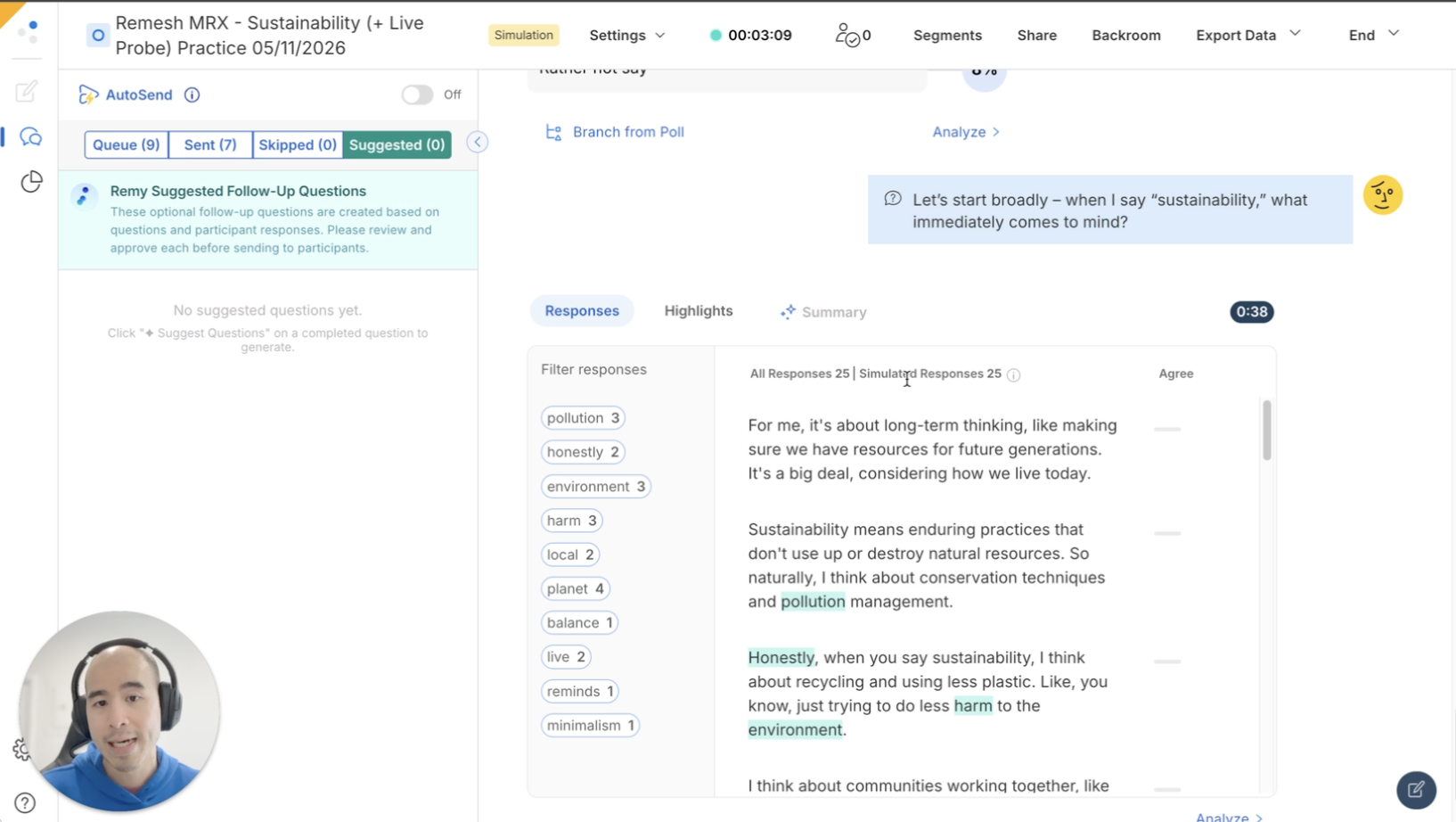
Remy is an AI agent purpose-built for research that delivers instant, defensible insights backed by verifiable data citations. Unlike generic large language models, Remy is embedded directly into Remesh (an AI-powered insights platform) with a proprietary retrieval-augmented generation (RAG) framework that ensures every insight is grounded in actual participant data.
Remy analyzes Remesh conversations, providing structured insights in approximately one minute including summaries and key takeaways, quantitative breakdowns from polls and rankings, qualitative themes with supporting participant quotes, and cross-segment comparison analysis.
The reduces manual labor, surfaces insights quickly, and helps communicate findings in ways that are both strategic and compelling.
Turning Data Into Decisions
With the right prompts, AI turns raw data into actionable insights, surfacing patterns, sentiment, and opportunities at scale. Teams that combine strong prompt design with research know-how can focus on interpretation and strategy, turning insights into faster, smarter decisions.
Try out the AI Research Agent, Remy today with a custom demo.
-
Lorem ipsum dolor sit amet, consectetur adipiscing elit. Suspendisse varius enim in eros elementum tristique. Duis cursus, mi quis viverra ornare, eros dolor interdum nulla, ut commodo diam libero vitae erat. Aenean faucibus nibh et justo cursus id rutrum lorem imperdiet. Nunc ut sem vitae risus tristique posuere.
-
Lorem ipsum dolor sit amet, consectetur adipiscing elit. Suspendisse varius enim in eros elementum tristique. Duis cursus, mi quis viverra ornare, eros dolor interdum nulla, ut commodo diam libero vitae erat. Aenean faucibus nibh et justo cursus id rutrum lorem imperdiet. Nunc ut sem vitae risus tristique posuere.
-
More
Scaling Up Civic Participation: How Remesh Can Bring Cypriot Voices into the Peace Process
Read More
Learn More
Stay up-to date.
Stay ahead of the curve. Get it all. Or get what suits you. Our 101 material is great if you’re used to working with an agency. Are you a seasoned pro? Sign up to receive just our advanced materials.


